Blog
Beyond Board Meetings: Creating Continuous Governance Across the Enterprise
31 Aug 2026
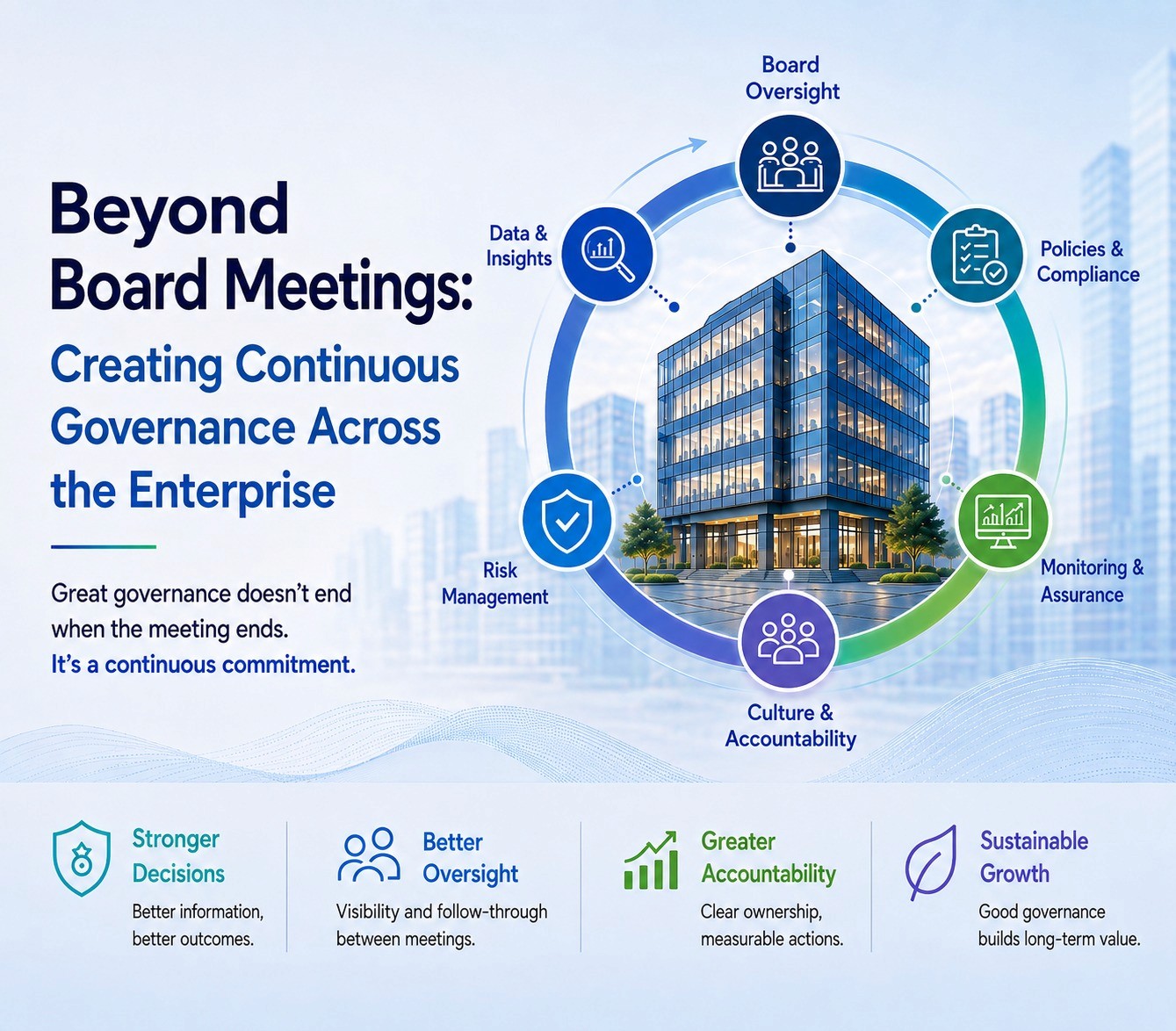
Governance does not start when directors sit down and end when they leave the room. Decisions made in the boardroom create actions that stretch across weeks and months. Information keeps flowing. Accountability stays active. However, when meetings are treated as isolated events, this creates gaps. Directors lose sight of progress. Follow-ups slip. Visibility fades.
Continuous governance changes this. It keeps board work alive between meetings. It links decisions to execution. It gives directors clear sight of what matters all year. The result is stronger board effectiveness, better board oversight, and higher governance maturity.
P. R. Ramesh, former head of Deloitte India, put it plainly in 2017. He spoke of moving from periodic governance to continuous governance. That shift suggestion still defines good practice today.
Why Governance Needs to Continue Between Meetings
A meeting ends. Directors walk out. Then the visibility gap opens.
Documents sit in email threads. Action items live in personal notes. Pending resolutions wait in scattered folders. Follow-ups depend on memory or chance reminders. Directors who need an update must dig through inboxes or call the company secretary. Time passes. Context fades. Oversight weakens.
This is not theory. Boards that rely only on quarterly inputs face delayed decisions. Risks surface late. Opportunities move without board input. Directors need access to relevant governance information throughout the year. Not once a quarter. Every week if needed.
Scattered communication creates another problem. Different directors hold different versions of the same document. One person tracks an action in a spreadsheet. Another tracks it in email. Alignment breaks. Accountability softens.
From Decisions to Ongoing Accountability
Every board resolution creates work. Someone must own it. Someone must finish it by a clear date. Without tracking, the decision loses force.
Decision tracking fixes this. Record the resolution. Assign the owner. Set the deadline. Monitor progress in real time. Before the next meeting arrives, the board sees closed items and open ones. In the interregnum, boards can be updated on progress as it happens. Then, continuity exists between what the board decided and what the organisation delivered.
This strengthens board oversight. Directors no longer ask basic status questions. They focus on results and risks. Accountability becomes visible. Owners know the board watches. Deadlines hold weight.
Example: A board approves a major capital project. The action tracker lists the project lead, key milestones, and reporting dates. Between meetings, the board receives alerts on delays. At the next sitting, the discussion starts with facts, not reconstruction.
Building Better Information Flow
Directors make better choices when they hold the right information at the right time. That requires structured board information management.
A central system stores agendas, supporting papers, past minutes, resolutions, and updates. Directors access one place and find current and historical records. No more hunting through email chains. No more outdated attachments.
Timely access supports informed decisions. A director preparing for a strategy discussion reviews the last three related resolutions in minutes. Historical context arrives without delay. New updates appear as they happen. The information flow stays continuous, not episodic.
Fragmented tools create friction. Email for one item. Shared drive for another. Chat for a third. Centralised flow removes that friction. Directors spend less time searching and more time thinking.
Making Governance Part of Everyday Operations
Periodic meetings alone no longer match the speed of business. Governance must sit inside daily workflows.
This means continuous compliance monitoring. Action tracking that runs every day. Secure channels for board communication. Instant document access. Resolution management that does not wait for the next formal sitting.
When these elements run together, the organisation reaches higher governance maturity. Governance stops being a calendar event. It becomes part of how the company works. Risks surface early. Actions close on time. Directors stay informed without extra effort.
Consider compliance. Regulatory deadlines do not align with board calendars. Continuous tracking flags upcoming filings across entities. Alerts reach the right people. The board sees continuing status updates, not just at the next meeting.
How Technology Enables Continuous Governance
Governance technology turns the idea into practice. It supplies the tools that keep visibility and accountability alive between meetings.
Key capabilities include:
Real-time dashboards and alerts that surface meetings, documents, votes, and actions at a glance
Digital meeting and resolution management that handles invites, quorum, and circular votes
Automated action tracking with owners, deadlines, and progress views
Secure board communications that replace unsecured email
Historical records and decision recall that put past context in one search
Continuous compliance tracking across entities and subsidiaries
BoardEye shows how these pieces connect. It links activities before, during, and after meetings into one environment. Directors log in and see critical updates immediately. Personalised action lists appear. Alerts arrive for new documents or votes. The board stays current without extra work.
The Shift from Periodic to Continuous Board Governance
Continuous governance improves four practical outcomes.
Visibility stays high. Directors see status between meetings instead of waiting for the next meeting agenda.
Decision continuity holds. Resolutions move into tracked actions with clear owners.
Accountability strengthens. Progress is measured in real time, not reconstructed later.
Board effectiveness rises. Meetings focus on forward issues rather than status recovery.
Effective corporate governance needs an ongoing flow of information and action. Isolated meetings leave gaps. Continuous practice closes them.
BoardEye turns this into daily reality.
With BoardEye, governance stops being a once-in-a-quarter event. It becomes continuous, accountable, and always under control.
Make Governance Continuous with Axar Digital
Axar Digital builds technology that keeps board oversight active every day. BoardEye brings meetings, decisions, documents, communications, actions, and compliance into one continuous environment. No gaps. No delays. Better-informed decisions every day.
Contact Axar Digital to schedule a walkthrough of BoardEye today to see continuous governance in action.
FAQs
1.What happens to board decisions after the meeting ends?
They move into tracked actions with clear owners and deadlines, so progress stays visible and accountability continues between meetings.
2.Why do directors need governance information all year instead of only at meetings?
Scattered emails and documents create visibility gaps. Continuous access keeps everyone informed and ready for better decisions.
3.How does BoardEye support ongoing board oversight?
It gives real-time dashboards, action tracking, secure communications, document access, and compliance alerts in one place, so governance never stops.
Governance does not start when directors sit down and end when they leave the room. Decisions made in the boardroom create actions that stretch across weeks and months. Information keeps flowing. Accountability stays active. However, when meetings are treated as isolated events, this creates gaps. Directors lose sight of progress. Follow-ups slip. Visibility fades.
Continuous governance changes this. It keeps board work alive between meetings. It links decisions to execution. It gives directors clear sight of what matters all year. The result is stronger board effectiveness, better board oversight, and higher governance maturity.
P. R. Ramesh, former head of Deloitte India, put it plainly in 2017. He spoke of moving from periodic governance to continuous governance. That shift suggestion still defines good practice today.
Why Governance Needs to Continue Between Meetings
A meeting ends. Directors walk out. Then the visibility gap opens.
Documents sit in email threads. Action items live in personal notes. Pending resolutions wait in scattered folders. Follow-ups depend on memory or chance reminders. Directors who need an update must dig through inboxes or call the company secretary. Time passes. Context fades. Oversight weakens.
This is not theory. Boards that rely only on quarterly inputs face delayed decisions. Risks surface late. Opportunities move without board input. Directors need access to relevant governance information throughout the year. Not once a quarter. Every week if needed.
Scattered communication creates another problem. Different directors hold different versions of the same document. One person tracks an action in a spreadsheet. Another tracks it in email. Alignment breaks. Accountability softens.
From Decisions to Ongoing Accountability
Every board resolution creates work. Someone must own it. Someone must finish it by a clear date. Without tracking, the decision loses force.
Decision tracking fixes this. Record the resolution. Assign the owner. Set the deadline. Monitor progress in real time. Before the next meeting arrives, the board sees closed items and open ones. In the interregnum, boards can be updated on progress as it happens. Then, continuity exists between what the board decided and what the organisation delivered.
This strengthens board oversight. Directors no longer ask basic status questions. They focus on results and risks. Accountability becomes visible. Owners know the board watches. Deadlines hold weight.
Example: A board approves a major capital project. The action tracker lists the project lead, key milestones, and reporting dates. Between meetings, the board receives alerts on delays. At the next sitting, the discussion starts with facts, not reconstruction.
Building Better Information Flow
Directors make better choices when they hold the right information at the right time. That requires structured board information management.
A central system stores agendas, supporting papers, past minutes, resolutions, and updates. Directors access one place and find current and historical records. No more hunting through email chains. No more outdated attachments.
Timely access supports informed decisions. A director preparing for a strategy discussion reviews the last three related resolutions in minutes. Historical context arrives without delay. New updates appear as they happen. The information flow stays continuous, not episodic.
Fragmented tools create friction. Email for one item. Shared drive for another. Chat for a third. Centralised flow removes that friction. Directors spend less time searching and more time thinking.
Making Governance Part of Everyday Operations
Periodic meetings alone no longer match the speed of business. Governance must sit inside daily workflows.
This means continuous compliance monitoring. Action tracking that runs every day. Secure channels for board communication. Instant document access. Resolution management that does not wait for the next formal sitting.
When these elements run together, the organisation reaches higher governance maturity. Governance stops being a calendar event. It becomes part of how the company works. Risks surface early. Actions close on time. Directors stay informed without extra effort.
Consider compliance. Regulatory deadlines do not align with board calendars. Continuous tracking flags upcoming filings across entities. Alerts reach the right people. The board sees continuing status updates, not just at the next meeting.
How Technology Enables Continuous Governance
Governance technology turns the idea into practice. It supplies the tools that keep visibility and accountability alive between meetings.
Key capabilities include:
Real-time dashboards and alerts that surface meetings, documents, votes, and actions at a glance
Digital meeting and resolution management that handles invites, quorum, and circular votes
Automated action tracking with owners, deadlines, and progress views
Secure board communications that replace unsecured email
Historical records and decision recall that put past context in one search
Continuous compliance tracking across entities and subsidiaries
BoardEye shows how these pieces connect. It links activities before, during, and after meetings into one environment. Directors log in and see critical updates immediately. Personalised action lists appear. Alerts arrive for new documents or votes. The board stays current without extra work.
The Shift from Periodic to Continuous Board Governance
Continuous governance improves four practical outcomes.
Visibility stays high. Directors see status between meetings instead of waiting for the next meeting agenda.
Decision continuity holds. Resolutions move into tracked actions with clear owners.
Accountability strengthens. Progress is measured in real time, not reconstructed later.
Board effectiveness rises. Meetings focus on forward issues rather than status recovery.
Effective corporate governance needs an ongoing flow of information and action. Isolated meetings leave gaps. Continuous practice closes them.
BoardEye turns this into daily reality.
With BoardEye, governance stops being a once-in-a-quarter event. It becomes continuous, accountable, and always under control.
Make Governance Continuous with Axar Digital
Axar Digital builds technology that keeps board oversight active every day. BoardEye brings meetings, decisions, documents, communications, actions, and compliance into one continuous environment. No gaps. No delays. Better-informed decisions every day.
Contact Axar Digital to schedule a walkthrough of BoardEye today to see continuous governance in action.
FAQs
1.What happens to board decisions after the meeting ends?
They move into tracked actions with clear owners and deadlines, so progress stays visible and accountability continues between meetings.
2.Why do directors need governance information all year instead of only at meetings?
Scattered emails and documents create visibility gaps. Continuous access keeps everyone informed and ready for better decisions.
3.How does BoardEye support ongoing board oversight?
It gives real-time dashboards, action tracking, secure communications, document access, and compliance alerts in one place, so governance never stops.