Blog
From Compliance to Culture: Building an Insider Trading-Resilient Organization
06 Aug 2026

Most listed companies have insider trading policies.
Designated persons (DPs) submit disclosures - either into the SDD directly or to the Company Secretary (CS) team for entry. The CS team circulates trading window closure notifications. Yet insider trading risks persist.
Why?
Because employees still discuss financial results in elevators, forward confidential emails without thinking, share sensitive information without understanding the consequences.
The real challenge isn't writing policies. It's creating an environment where every employee understands and appreciates why protecting Unpublished Price Sensitive Information (UPSI) matters and treats governance as part of daily work.
This matters more than ever. SEBI is stepping up inspections and increasing accountability. Organizations that wait for regulatory scrutiny before strengthening compliance take a serious risk. A strong compliance culture isn't optional anymore - it's a regulatory requirement for sustainable operations.
Why PIT Compliance Is More Than Policies and Procedures
Many organizations confuse documentation with compliance. A policy document doesn't stop information leakage. Employee behaviour does.
Consider a quarterly financial announcement. Finance prepares the numbers. Statutory Auditors vet them and approve. CS and Investor Relations prepare the communication. Senior leadership at the Board approves the announcement.
If one employee casually discusses expected results before public disclosure, every written policy becomes meaningless.
Leadership Sets the Tone
Employees watch leadership more closely than they read policy documents.
When directors and senior executives handle confidential information carefully, employees notice. When leaders ignore governance processes, employees notice that too.
Leadership shapes compliance through everyday actions:
· Protecting confidential discussions during meetings
· Following information-sharing protocols
· Supporting compliance teams during business decisions
· Reporting concerns promptly
Culture starts at the top. When leadership insists that every merger discussion follows controlled access protocols, documents every approval, and records every stakeholder interaction, employees understand that confidentiality is a business priority.
The opposite sends a dangerous message. If executives discuss sensitive projects over unsecured channels, employees assume those shortcuts are acceptable.
The Behavioral Risks Policies Can't Fix
Most insider incidents start with everyday habits, not malice.
· Casual conversations
· Oversharing – “just for context” spreads UPSI far beyond need-to-know.
· Digital slip-ups – forwarding emails, screenshotting, using personal apps, leaving files accessible post-project.
· Assumptions – “everyone knows,” “this isn’t sensitive,” “just helping a colleague.”
Why Compliance Culture Matters Now
The SEBI (PIT) Regulations have existed since 1992. But the regulatory environment has shifted significantly since 2019. The Structured Digital Database (SDD) requirement became mandatory from April 1, 2019.
This timeline matters because organizations should already have mature compliance practices. The expectation is no longer about having policies - it's about demonstrating continuous, digital-first governance. Organizations still relying on manual processes are falling behind. Digital compliance is not optional. It's an established regulatory expectation.
Designated Persons: Beyond Annual Training
Designated Persons handle UPSI regularly. They need ongoing awareness, not yearly slides.
Effective programmes use real-world scenarios:
· Spotting UPSI in business contexts
· Understanding insider duties
· Applying trading-window rules
· Classifying information
· Secure sharing
· Escalation steps
· Case discussions
Building Accountability for UPSI Handling
Who identifies UPSI? Who classifies? Who validates access? Who logs information flow?
Without clear answers, responsibility scatters. Assign ownership clearly:
Role | Primary Responsibility |
Information creators | Identify potential UPSI early |
Business leaders | Confirm business sensitivity |
Compliance teams | Validate classification and maintain records |
Employees | Follow approved access protocols |
Leadership | Reinforce governance discipline |
Equally important is traceability. Organizations should answer five simple questions for every movement of UPSI.
· Who created the information?
· Who accessed it?
· Why was access granted?
· When was information shared?
· What actions followed?
Digital systems make this process structured and audit-ready. Maintaining an SDD creates reliable records, improves visibility, and strengthens governance across the information lifecycle.
Insider Trading Compliance Belongs to Every Department
Too often, PIT compliance is seen as the Company Secretary’s or Compliance Officer’s burden.
Wrong.
Every department handles UPSI such as financial results, leadership changes, litigation, strategic transactions, and market disclosures.
Each function influences information flow. HR manages leadership transitions before public announcements. Strategy teams handle confidential acquisition discussions. Finance prepares earnings reports weeks before disclosure.
Every team becomes part of the governance process.
The Hidden Costs of Weak Compliance Culture
A weak compliance culture carries consequences far beyond regulatory exposure. The impact extends across multiple dimensions of organizational health:
· Reputational damage: Insider trading incidents tarnish brand reputation, erode stakeholder trust, and create lasting negative perceptions.
· Reduced investor confidence: Investors evaluate governance practices when making investment decisions. Weak compliance cultures signal poor management.
· Increased regulatory scrutiny: Organizations with compliance concerns attract more regulatory attention, additional inspections, and greater operational burden.
· Regulatory exposure: Financial penalties, enforcement actions, and potential restrictions on future market participation.
· Employee morale & retention: When governance failures occur, employees lose confidence in leadership. Top talent often seeks opportunities in organizations with stronger governance cultures.
These risks compound over time. A single compliance failure can undo years of reputation building.
Measuring Compliance Maturity
Passing an audit does not automatically indicate strong governance. A mature organization measures behaviour alongside documentation.
Useful indicators include:
1. Awareness – training completion, quiz scores, UPSI understanding.
2. Operations – classification speed, approval timelines, trading-window adherence, SDD completeness and timeliness.
3. Behaviour – voluntary reporting, clarification requests, early escalations.
4. Governance – leadership involvement, cross-functional reviews, discussion frequency.
These indicators provide a clearer picture of organizational maturity. When employees ask questions before sharing sensitive information, governance is improving. When teams report potential issues early, compliance becomes proactive instead of reactive.
Making Compliance an Organizational Value
The strongest organizations treat governance as part of everyday business.
Employees encounter compliance throughout their work during onboarding, project discussions, leadership meetings, performance conversations, information sharing.
This approach creates long-term advantages.
· Stronger investor confidence.
· Better protection of confidential information.
· Improved governance transparency.
· Reduced regulatory exposure.
· Greater trust across stakeholders.
Employees begin protecting confidential information because responsible governance becomes part of organizational identity.
Policies establish expectations. Culture reinforces them every day.
Conclusion
· Building sustainable PIT compliance requires more than policies.
· Organizations need leadership commitment, continuous employee awareness, structured accountability, secure information management, and shared ownership across departments.
· Culture determines whether compliance succeeds.
· As governance expectations continue to grow, listed companies need systems that support secure, digital, and continuous compliance every day.
· Organizations can improve employee awareness through regular trainings and periodic refreshers.
Build a Stronger Insider Trading Compliance Framework with Axar Digital.
Create a resilient governance culture starting with the right processes and right technology.
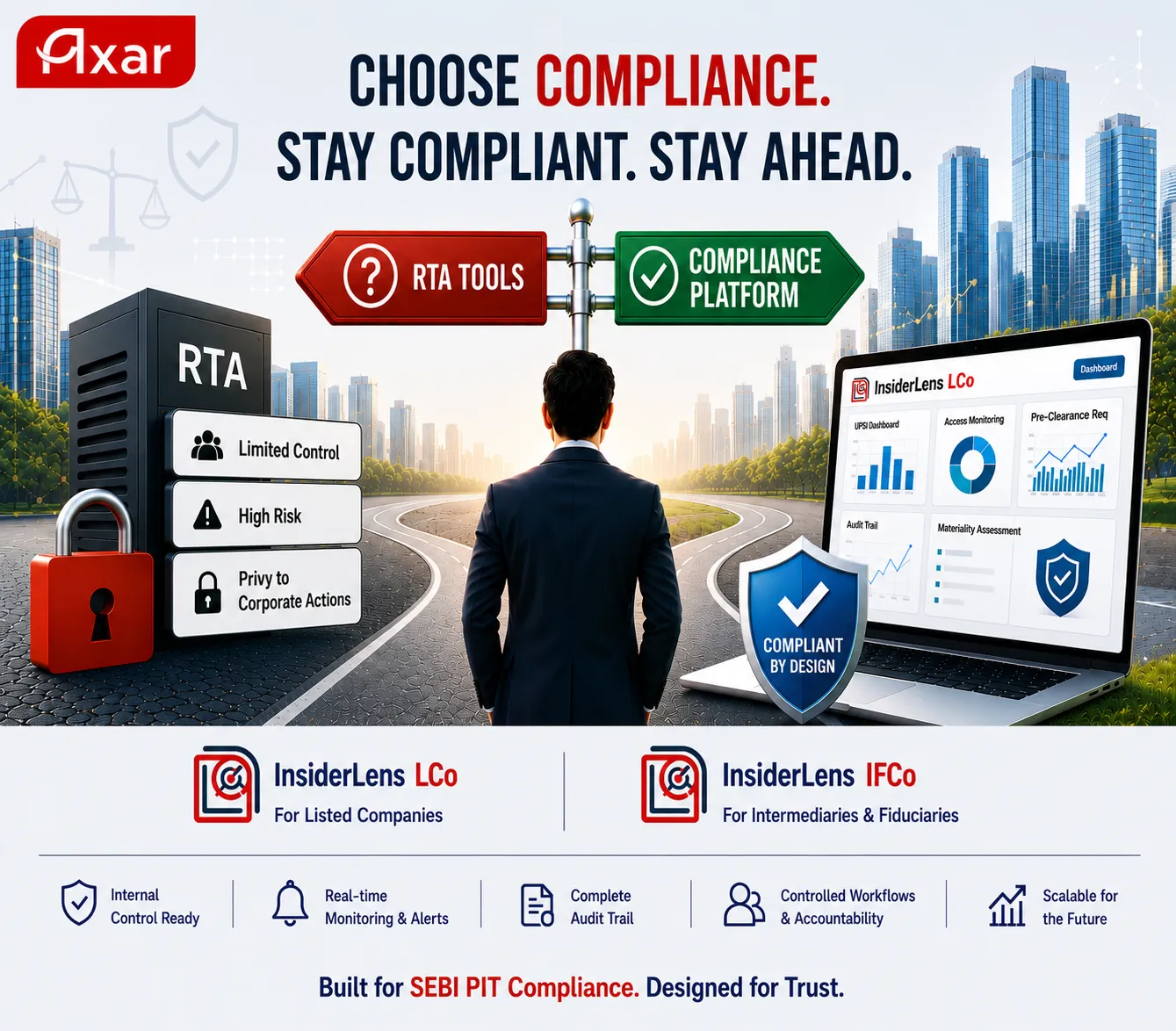
With InsiderLens LCo and InsiderLens IFCo, organizations gain structured UPSI management, controlled access tracking, SDD management, trading window controls, and secure compliance records. Combined with continuous governance practices and Designated Person awareness, these solutions help organizations build stronger insider trading compliance, reinforce a lasting compliance culture, and support responsible corporate governance every day.
Most listed companies have insider trading policies.
Designated persons (DPs) submit disclosures - either into the SDD directly or to the Company Secretary (CS) team for entry. The CS team circulates trading window closure notifications. Yet insider trading risks persist.
Why?
Because employees still discuss financial results in elevators, forward confidential emails without thinking, share sensitive information without understanding the consequences.
The real challenge isn't writing policies. It's creating an environment where every employee understands and appreciates why protecting Unpublished Price Sensitive Information (UPSI) matters and treats governance as part of daily work.
This matters more than ever. SEBI is stepping up inspections and increasing accountability. Organizations that wait for regulatory scrutiny before strengthening compliance take a serious risk. A strong compliance culture isn't optional anymore - it's a regulatory requirement for sustainable operations.
Why PIT Compliance Is More Than Policies and Procedures
Many organizations confuse documentation with compliance. A policy document doesn't stop information leakage. Employee behaviour does.
Consider a quarterly financial announcement. Finance prepares the numbers. Statutory Auditors vet them and approve. CS and Investor Relations prepare the communication. Senior leadership at the Board approves the announcement.
If one employee casually discusses expected results before public disclosure, every written policy becomes meaningless.
Leadership Sets the Tone
Employees watch leadership more closely than they read policy documents.
When directors and senior executives handle confidential information carefully, employees notice. When leaders ignore governance processes, employees notice that too.
Leadership shapes compliance through everyday actions:
· Protecting confidential discussions during meetings
· Following information-sharing protocols
· Supporting compliance teams during business decisions
· Reporting concerns promptly
Culture starts at the top. When leadership insists that every merger discussion follows controlled access protocols, documents every approval, and records every stakeholder interaction, employees understand that confidentiality is a business priority.
The opposite sends a dangerous message. If executives discuss sensitive projects over unsecured channels, employees assume those shortcuts are acceptable.
The Behavioral Risks Policies Can't Fix
Most insider incidents start with everyday habits, not malice.
· Casual conversations
· Oversharing – “just for context” spreads UPSI far beyond need-to-know.
· Digital slip-ups – forwarding emails, screenshotting, using personal apps, leaving files accessible post-project.
· Assumptions – “everyone knows,” “this isn’t sensitive,” “just helping a colleague.”
Why Compliance Culture Matters Now
The SEBI (PIT) Regulations have existed since 1992. But the regulatory environment has shifted significantly since 2019. The Structured Digital Database (SDD) requirement became mandatory from April 1, 2019.
This timeline matters because organizations should already have mature compliance practices. The expectation is no longer about having policies - it's about demonstrating continuous, digital-first governance. Organizations still relying on manual processes are falling behind. Digital compliance is not optional. It's an established regulatory expectation.
Designated Persons: Beyond Annual Training
Designated Persons handle UPSI regularly. They need ongoing awareness, not yearly slides.
Effective programmes use real-world scenarios:
· Spotting UPSI in business contexts
· Understanding insider duties
· Applying trading-window rules
· Classifying information
· Secure sharing
· Escalation steps
· Case discussions
Building Accountability for UPSI Handling
Who identifies UPSI? Who classifies? Who validates access? Who logs information flow?
Without clear answers, responsibility scatters. Assign ownership clearly:
Role | Primary Responsibility |
Information creators | Identify potential UPSI early |
Business leaders | Confirm business sensitivity |
Compliance teams | Validate classification and maintain records |
Employees | Follow approved access protocols |
Leadership | Reinforce governance discipline |
Equally important is traceability. Organizations should answer five simple questions for every movement of UPSI.
· Who created the information?
· Who accessed it?
· Why was access granted?
· When was information shared?
· What actions followed?
Digital systems make this process structured and audit-ready. Maintaining an SDD creates reliable records, improves visibility, and strengthens governance across the information lifecycle.
Insider Trading Compliance Belongs to Every Department
Too often, PIT compliance is seen as the Company Secretary’s or Compliance Officer’s burden.
Wrong.
Every department handles UPSI such as financial results, leadership changes, litigation, strategic transactions, and market disclosures.
Each function influences information flow. HR manages leadership transitions before public announcements. Strategy teams handle confidential acquisition discussions. Finance prepares earnings reports weeks before disclosure.
Every team becomes part of the governance process.
The Hidden Costs of Weak Compliance Culture
A weak compliance culture carries consequences far beyond regulatory exposure. The impact extends across multiple dimensions of organizational health:
· Reputational damage: Insider trading incidents tarnish brand reputation, erode stakeholder trust, and create lasting negative perceptions.
· Reduced investor confidence: Investors evaluate governance practices when making investment decisions. Weak compliance cultures signal poor management.
· Increased regulatory scrutiny: Organizations with compliance concerns attract more regulatory attention, additional inspections, and greater operational burden.
· Regulatory exposure: Financial penalties, enforcement actions, and potential restrictions on future market participation.
· Employee morale & retention: When governance failures occur, employees lose confidence in leadership. Top talent often seeks opportunities in organizations with stronger governance cultures.
These risks compound over time. A single compliance failure can undo years of reputation building.
Measuring Compliance Maturity
Passing an audit does not automatically indicate strong governance. A mature organization measures behaviour alongside documentation.
Useful indicators include:
1. Awareness – training completion, quiz scores, UPSI understanding.
2. Operations – classification speed, approval timelines, trading-window adherence, SDD completeness and timeliness.
3. Behaviour – voluntary reporting, clarification requests, early escalations.
4. Governance – leadership involvement, cross-functional reviews, discussion frequency.
These indicators provide a clearer picture of organizational maturity. When employees ask questions before sharing sensitive information, governance is improving. When teams report potential issues early, compliance becomes proactive instead of reactive.
Making Compliance an Organizational Value
The strongest organizations treat governance as part of everyday business.
Employees encounter compliance throughout their work during onboarding, project discussions, leadership meetings, performance conversations, information sharing.
This approach creates long-term advantages.
· Stronger investor confidence.
· Better protection of confidential information.
· Improved governance transparency.
· Reduced regulatory exposure.
· Greater trust across stakeholders.
Employees begin protecting confidential information because responsible governance becomes part of organizational identity.
Policies establish expectations. Culture reinforces them every day.
Conclusion
· Building sustainable PIT compliance requires more than policies.
· Organizations need leadership commitment, continuous employee awareness, structured accountability, secure information management, and shared ownership across departments.
· Culture determines whether compliance succeeds.
· As governance expectations continue to grow, listed companies need systems that support secure, digital, and continuous compliance every day.
· Organizations can improve employee awareness through regular trainings and periodic refreshers.
Build a Stronger Insider Trading Compliance Framework with Axar Digital.
Create a resilient governance culture starting with the right processes and right technology.
With InsiderLens LCo and InsiderLens IFCo, organizations gain structured UPSI management, controlled access tracking, SDD management, trading window controls, and secure compliance records. Combined with continuous governance practices and Designated Person awareness, these solutions help organizations build stronger insider trading compliance, reinforce a lasting compliance culture, and support responsible corporate governance every day.