Blog
Carbon Independent by 2037 or 2047? Why India’s Top 2,000 Companies Need a Long-Term Sustainability Vision
July 30, 2026
Every successful business plans for the future. The best decisions are made early, long before they become urgent. Sustainability is one of those decisions.
The Government of India has committed to achieving net-zero carbon emissions by 2070 (NZ2070). India's largest companies have good reasons to begin much earlier. Changing large factories, business systems, technology, and supply chains takes many years. These companies also have greater control over where they invest, how they work, and how they plan for the future. Most importantly, because Sustainability is the basic premise on which long-term existence and growth are both predicated.
A long-term sustainability strategy intrinsically creates lasting business value while simultaneously supporting India's sustainability goals. Sustainable practices improve efficiency, strengthen operations, reduce future risks, build trust, and thereby create lasting business value.
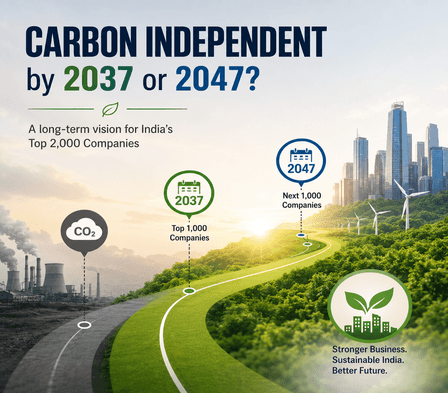
A practical way forward could begin with India's Top 1,000 companies working towards Carbon Independence by 2037. The next 1,000 companies could aim for 2047 by learning from the experience, systems, and good practices built by the first group.
Starting early gives businesses enough time to improve the way they work, use cleaner technology, cut carbon emissions, improve the way their suppliers function, and keep growing more and more efficiently. It also gives India time to create its own clear rules, set standards & guidelines, and work out practices that companies can follow to achieve NetZero emission goals for themselves, while helping the country reach its long-term environmental goals.
Why Net Zero by 2037 and 2047
Many companies plan for the next financial year. Businesses that keep growing for many years also plan much further ahead. That is why the 2037 and 2047 goals matter. Also because these are goals that can only be achieved through sustained and persistent effort – not just quick-fixes or one-time reporting activity.
When large companies move forward, their suppliers and other related businesses move forward with them. In this way, they all become catalysts for bringing about change across the entire economy. This is one of the best ways to support the nation’s Net Zero journey.
Large businesses need time to make big changes. Improving factories, using cleaner technology, cutting carbon emissions, and working better with suppliers all take time. Having enough time makes these changes easier while helping businesses keep growing.
Planning early also helps companies make better choices. They can make sustainability part of their everyday work, replace old machines at the right time, save more energy, choose better suppliers, and prepare for future customer needs and new government rules.
Starting early also helps India move closer to its long-term environmental goals. When large companies improve the way they work, suppliers and many other businesses often improve too. Over time, these changes spread across many businesses and help India build a cleaner and stronger future.
Sustainability is a Leadership Responsibility
Earlier, one team mainly looked after sustainability. Today, it is part of almost every important business decision, so leaders across the business need to share the responsibility.
Building a factory, buying new technology, choosing suppliers, or growing the business can affect carbon emissions for many years. That is why sustainability should be part of these decisions from the beginning.
Strong ESG governance gives people clear responsibility and helps every team work towards the same goal. It also helps leaders see progress and make better decisions. Investors also look for businesses that plan early and think ahead.
Reaching net-zero carbon emissions comes from many good decisions made over time. Every investment, technology upgrade, supplier choice, factory improvement, and business expansion helps move the business closer to its goal.
The Business Value of a Long-Term Sustainability Strategy
Internationally, it has been realised that Sustainability is one of the surest pathways to business success as well. Sustainable activities are also the most business efficient activities. There is enough evidence from large and small business worldwide. One of the easiest examples from overseas, and one that is now well-documented is the journey of Unilver (www.unilever.com/sustainability). It is certainly not the only such organisation in the world, it is simply the one that comes easiest to mind because it has a significant presence in Bharat as well.
Sustainability is also therefore the smartest business sense. Short-cuts which appear immediately profitable are clearly much less so in the long run. Sustainability on the other hand is the best way to ensure the survival and the most profitable survival of any business. Rather than launch into a long explanation as to how in this article, I am going to make it the subject of several more going forward. Not only from me, with my little experience, but from many more experienced and successful entrepreneurs and corporate executives who has seen this happen.
Hence, without being preachy, I’ll just stop here on this point – a long-term Sustainability approach is the best value strategy for any business.
A long-term plan also changes the way leaders think. They look beyond today's results. They also think about the value every investment can create in the years ahead.
This approach supports better investments, stronger business growth, and lasting value. Sustainability goes beyond social responsibility. It helps businesses work better today and build a stronger future.
India’s Top 2,000 Companies Can Shape Entire Industries
India's top 2,000 companies influence far more than their own business. Their decisions affect many other businesses across the country.
When sustainability becomes part of supplier selection, purchasing, daily operations, and performance reviews, better ways of working spread across the supply chain. Suppliers, manufacturers, service providers, and smaller businesses improve the way they work.
The first 1,000 companies have an important role. As they work towards the 2037 goal, they can develop practical methods, systems, and lessons that the next 1,000 companies can use. This can make the journey towards 2047 easier because companies can build on proven experience.
These improvements strengthen supply chains, improve the way businesses work, and build greater customer trust. Together, they support India's sustainability goals and help reduce carbon emissions.
That is why the 2037 and 2047 goals go beyond individual company targets. They help create lasting value for businesses, people, industries, and future generations.
Building an Indian Sustainability Standards Institution (SustaInit)
Individual companies can make progress, and shared standards and guidance can help them move further together.
Industry bodies such as the Association of Chambers of Commerce (ASSOCHAM) and Confederation of Indian Industry (CII) and the Federation of Indian Chambers of Commerce and Industry (FICCI) could bring businesses, experts, institutions, and business leaders together. They could also help create a Bharatiya Sustainability Targets Institution (BSTI) or Bharat Sustainability Initiative (Bharat SustaInit or just SustaInit) built for Bharatiya business needs while learning from global sustainability organisations and individuals.
SustaInit could help businesses set practical goals, create common standards, measure progress, improve reporting, and prepare clear Net Zero plans. It could also support companies with limited knowledge or resources and share practical lessons with other businesses across the supply chain.
Funding could come from Indian entrepreneurs, business leaders, and organisations such as the Infosys founders, Mr. Azim Premji, the AV Birla Group, the Tata Group, Kotak Bank, other private banks, Zerodha, and others. The Indian Institute for Human Settlements (IIHS) shows how long-term national institutions can be built through shared commitment.
Together, SustaInit and the companies it supports can build the knowledge, standards, and experience that help more businesses move towards Carbon Independence with greater confidence.
Conclusion
Sustainability is the raison d’etre of every business. It is a foundational pillar of Bharatiya culture – Vasudhaiva Kutumbakam. It is therefore natural for Indian business to incorporate sustainability thinking into their strategy and practice.
However, every meaningful change begins with a clear first step. Setting a goal of Carbon Independence by 2037 (CI2037) for India's first 1,000 companies and by CI2047 for the next 1,000 companies would give businesses enough time to plan and move forward with purpose.
Better planning, responsible investment, strong ESG governance, and steady action can build stronger businesses. Together, they can reduce carbon emissions, strengthen supply chains, build trust, manage future risks, and create lasting value.As large companies guide suppliers and influence industries, every responsible decision can create a much wider impact.
A shared institution, say SustaInit, could help companies set-up and follow commonly understood, appreciated and accepted standards, receive guidance, and move towards their goals together.
Axar Digital and our partner CogniTensor helps organisations build strong ESG governance and clear sustainability processes to turn goals into clear business action supporting India's Net Zero journey.
Every successful business plans for the future. The best decisions are made early, long before they become urgent. Sustainability is one of those decisions.
The Government of India has committed to achieving net-zero carbon emissions by 2070 (NZ2070). India's largest companies have good reasons to begin much earlier. Changing large factories, business systems, technology, and supply chains takes many years. These companies also have greater control over where they invest, how they work, and how they plan for the future. Most importantly, because Sustainability is the basic premise on which long-term existence and growth are both predicated.
A long-term sustainability strategy intrinsically creates lasting business value while simultaneously supporting India's sustainability goals. Sustainable practices improve efficiency, strengthen operations, reduce future risks, build trust, and thereby create lasting business value.
A practical way forward could begin with India's Top 1,000 companies working towards Carbon Independence by 2037. The next 1,000 companies could aim for 2047 by learning from the experience, systems, and good practices built by the first group.
Starting early gives businesses enough time to improve the way they work, use cleaner technology, cut carbon emissions, improve the way their suppliers function, and keep growing more and more efficiently. It also gives India time to create its own clear rules, set standards & guidelines, and work out practices that companies can follow to achieve NetZero emission goals for themselves, while helping the country reach its long-term environmental goals.
Why Net Zero by 2037 and 2047
Many companies plan for the next financial year. Businesses that keep growing for many years also plan much further ahead. That is why the 2037 and 2047 goals matter. Also because these are goals that can only be achieved through sustained and persistent effort – not just quick-fixes or one-time reporting activity.
When large companies move forward, their suppliers and other related businesses move forward with them. In this way, they all become catalysts for bringing about change across the entire economy. This is one of the best ways to support the nation’s Net Zero journey.
Large businesses need time to make big changes. Improving factories, using cleaner technology, cutting carbon emissions, and working better with suppliers all take time. Having enough time makes these changes easier while helping businesses keep growing.
Planning early also helps companies make better choices. They can make sustainability part of their everyday work, replace old machines at the right time, save more energy, choose better suppliers, and prepare for future customer needs and new government rules.
Starting early also helps India move closer to its long-term environmental goals. When large companies improve the way they work, suppliers and many other businesses often improve too. Over time, these changes spread across many businesses and help India build a cleaner and stronger future.
Sustainability is a Leadership Responsibility
Earlier, one team mainly looked after sustainability. Today, it is part of almost every important business decision, so leaders across the business need to share the responsibility.
Building a factory, buying new technology, choosing suppliers, or growing the business can affect carbon emissions for many years. That is why sustainability should be part of these decisions from the beginning.
Strong ESG governance gives people clear responsibility and helps every team work towards the same goal. It also helps leaders see progress and make better decisions. Investors also look for businesses that plan early and think ahead.
Reaching net-zero carbon emissions comes from many good decisions made over time. Every investment, technology upgrade, supplier choice, factory improvement, and business expansion helps move the business closer to its goal.
The Business Value of a Long-Term Sustainability Strategy
Internationally, it has been realised that Sustainability is one of the surest pathways to business success as well. Sustainable activities are also the most business efficient activities. There is enough evidence from large and small business worldwide. One of the easiest examples from overseas, and one that is now well-documented is the journey of Unilver (www.unilever.com/sustainability). It is certainly not the only such organisation in the world, it is simply the one that comes easiest to mind because it has a significant presence in Bharat as well.
Sustainability is also therefore the smartest business sense. Short-cuts which appear immediately profitable are clearly much less so in the long run. Sustainability on the other hand is the best way to ensure the survival and the most profitable survival of any business. Rather than launch into a long explanation as to how in this article, I am going to make it the subject of several more going forward. Not only from me, with my little experience, but from many more experienced and successful entrepreneurs and corporate executives who has seen this happen.
Hence, without being preachy, I’ll just stop here on this point – a long-term Sustainability approach is the best value strategy for any business.
A long-term plan also changes the way leaders think. They look beyond today's results. They also think about the value every investment can create in the years ahead.
This approach supports better investments, stronger business growth, and lasting value. Sustainability goes beyond social responsibility. It helps businesses work better today and build a stronger future.
India’s Top 2,000 Companies Can Shape Entire Industries
India's top 2,000 companies influence far more than their own business. Their decisions affect many other businesses across the country.
When sustainability becomes part of supplier selection, purchasing, daily operations, and performance reviews, better ways of working spread across the supply chain. Suppliers, manufacturers, service providers, and smaller businesses improve the way they work.
The first 1,000 companies have an important role. As they work towards the 2037 goal, they can develop practical methods, systems, and lessons that the next 1,000 companies can use. This can make the journey towards 2047 easier because companies can build on proven experience.
These improvements strengthen supply chains, improve the way businesses work, and build greater customer trust. Together, they support India's sustainability goals and help reduce carbon emissions.
That is why the 2037 and 2047 goals go beyond individual company targets. They help create lasting value for businesses, people, industries, and future generations.
Building an Indian Sustainability Standards Institution (SustaInit)
Individual companies can make progress, and shared standards and guidance can help them move further together.
Industry bodies such as the Association of Chambers of Commerce (ASSOCHAM) and Confederation of Indian Industry (CII) and the Federation of Indian Chambers of Commerce and Industry (FICCI) could bring businesses, experts, institutions, and business leaders together. They could also help create a Bharatiya Sustainability Targets Institution (BSTI) or Bharat Sustainability Initiative (Bharat SustaInit or just SustaInit) built for Bharatiya business needs while learning from global sustainability organisations and individuals.
SustaInit could help businesses set practical goals, create common standards, measure progress, improve reporting, and prepare clear Net Zero plans. It could also support companies with limited knowledge or resources and share practical lessons with other businesses across the supply chain.
Funding could come from Indian entrepreneurs, business leaders, and organisations such as the Infosys founders, Mr. Azim Premji, the AV Birla Group, the Tata Group, Kotak Bank, other private banks, Zerodha, and others. The Indian Institute for Human Settlements (IIHS) shows how long-term national institutions can be built through shared commitment.
Together, SustaInit and the companies it supports can build the knowledge, standards, and experience that help more businesses move towards Carbon Independence with greater confidence.
Conclusion
Sustainability is the raison d’etre of every business. It is a foundational pillar of Bharatiya culture – Vasudhaiva Kutumbakam. It is therefore natural for Indian business to incorporate sustainability thinking into their strategy and practice.
However, every meaningful change begins with a clear first step. Setting a goal of Carbon Independence by 2037 (CI2037) for India's first 1,000 companies and by CI2047 for the next 1,000 companies would give businesses enough time to plan and move forward with purpose.
Better planning, responsible investment, strong ESG governance, and steady action can build stronger businesses. Together, they can reduce carbon emissions, strengthen supply chains, build trust, manage future risks, and create lasting value.As large companies guide suppliers and influence industries, every responsible decision can create a much wider impact.
A shared institution, say SustaInit, could help companies set-up and follow commonly understood, appreciated and accepted standards, receive guidance, and move towards their goals together.
Axar Digital and our partner CogniTensor helps organisations build strong ESG governance and clear sustainability processes to turn goals into clear business action supporting India's Net Zero journey.