Blog
Why Listed Companies Should Reconsider Relying on RTA-Provided Tools for PIT Compliance
July 13,2026
For a long time, many listed companies have relied on their Registrar and Transfer Agents (RTAs) for a broad range of compliance-related functions, including tools for SEBI PIT Compliance. It seemed practical at the time. RTAs already held shareholder data. The infrastructure existed. Adding a compliance layer on top appeared to be a natural extension.
But the regulatory environment has changed significantly. Insider Trading Compliance is no longer a documentation exercise. It now demands governance, real-time oversight, and audit-ready processes, which are areas where RTA-provided tools have serious limitations.
There is also a more fundamental question worth asking: should a company that handles your corporate actions, and therefore has potentially prior access to price-sensitive information itself, also be the one supplying the software used to monitor and record that same information?
A. RTAs Were Not Designed for This
RTAs serve a well-defined purpose: shareholder servicing, registry management, and corporate action processing. They are good at what they do. The problem is that Insider Trading Compliance demands a different set of capabilities entirely.
Registry-Centric Approach | Governance-Centric Compliance |
Focuses on records | Focuses on accountability |
Supports administrative processes | Supports regulatory oversight |
Reactive documentation | Proactive monitoring |
Transaction-oriented | Governance-oriented |
Beyond design intent, there is a track record worth noting. Initially, some RTAs hosted their clients' Structured Digital Database (SDD) on their own servers. SEBI clarified this was not permitted under the regulations, as the SDD must be maintained internally by the listed entity with adequate internal controls, time-stamping, and audit trails.
RTAs then pivoted to providing software installed on client servers. These solutions have come with meaningful constraints, including limitations on the number of Designated Persons who can use them.
To maintain client stickiness, some RTAs have also bundled BenPos statement features into their tools. These features present folio-based or depository-account-based BenPos rather than the PAN-based BenPos that regulations require. This is a convenience feature, not a compliance one. It creates an appearance of integration while the actual regulatory requirement is being met differently.
B. RTAs Are Not Neutral Parties in This Equation
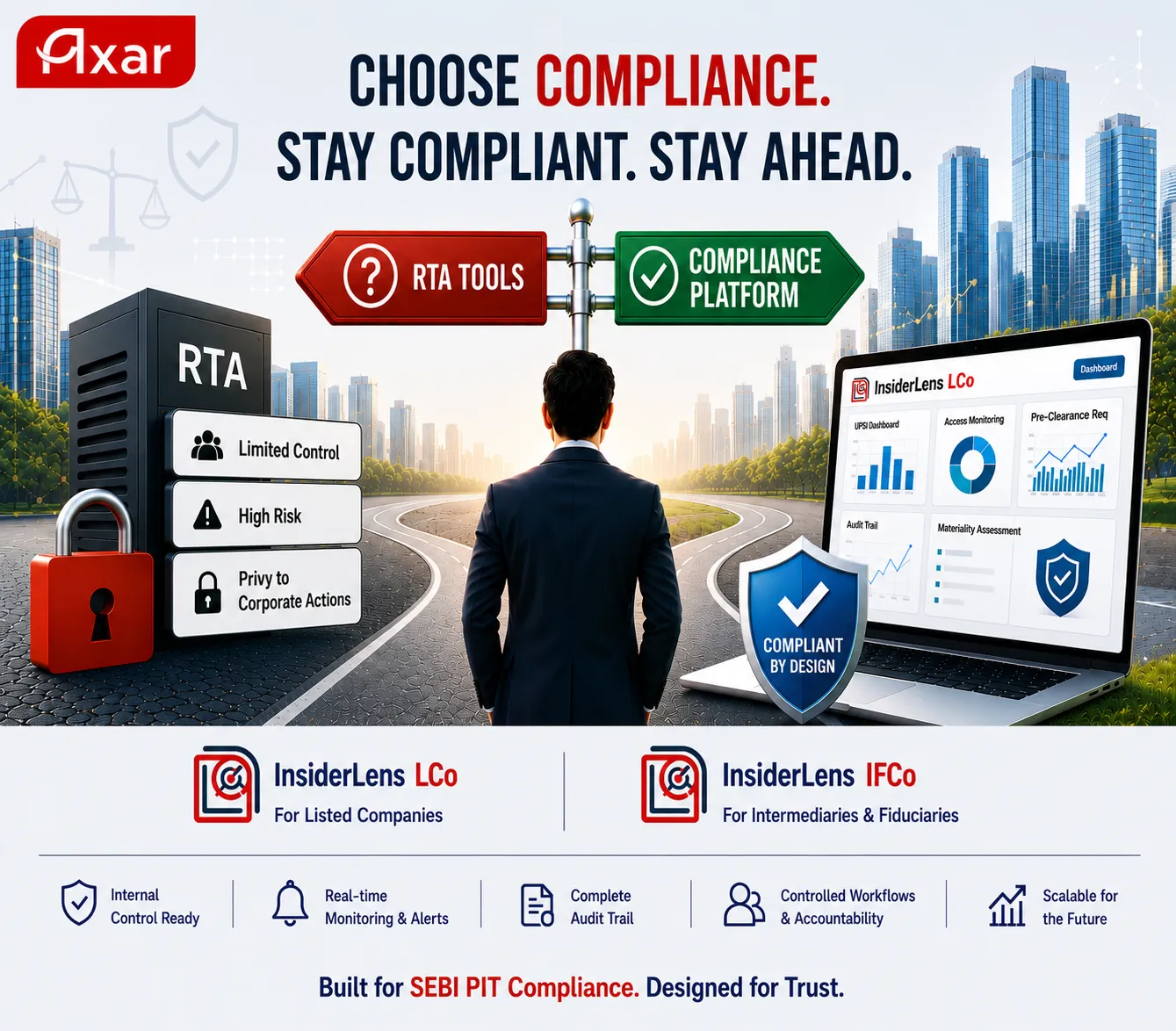
This is the part that often goes unexamined. RTAs are privy to corporate actions. A company's merger, a dividend declaration, or a restructuring initiative all pass through the RTA's hands before they become public. This proximity to material information puts RTAs in a position that is, functionally, close to that of a connected person under SEBI regulations.
The SEBI PIT Regulations for Mutual Funds make this explicit. Under Chapter IIA, Registrar and Share Transfer Agents are listed as a category of Connected Persons because they have access, or are reasonably expected to have access, to unpublished price-sensitive information in the course of their business operations.
While this provision currently applies to mutual funds, the underlying principle is clear. Entities with structural proximity to UPSI carry an inherent conflict of interest when they also supply the software used to manage, record, and track that same information. For listed companies, the governance question is direct: should the entity that handles your corporate actions also be the one supplying the platform where your Designated Persons log UPSI access and trading decisions?
Relying on such a platform for UPSI Management introduces a dependency that regulators may scrutinize more closely over time. It is not unreasonable to expect SEBI to restrict this practice, extending similar reasoning to listed entities as it already has for mutual funds.
C. The Scalability Problem Is Real
As organizations grow, compliance complexity increases. More subsidiaries, larger insider populations, more frequent board interactions, external advisors, and greater regulatory scrutiny all require systems that can scale accordingly.
RTA-provided tools, built around registry functions and often constrained in the number of Designated Persons they support, are not architected for this. The result is predictable: manual workarounds accumulate, compliance data gets spread across multiple systems, and audit preparation becomes a resource-heavy exercise.
The question is not just whether the current system works today. The question is whether it will support governance demands two or three years from now.
D. What Future-Ready PIT Compliance Actually Requires
A fit-for-purpose SEBI PIT Compliance platform should provide:
Centralized governance visibility across the organization
Real-time monitoring and management-level reporting
Complete audit trails, including access logs, approval records, and exception tracking
Internally maintained Structured Digital Database (SDD) with time-stamping and tamper protection
Controlled information-sharing workflows with clear accountability at each stage
Scalable Designated Person management without artificial user caps
These are not aspirational features. They reflect what regulators already expect. The gap between what RTA-provided tools were built to do and what modern Insider Trading Compliance requires is not a minor technical detail. It is a governance gap.
E. The Right Question to Ask
The issue is not whether RTA tools are useful. They are, for the functions they were designed to serve. The issue is whether they are sufficient and, more importantly, whether they are dependable in the medium to long term.
Given SEBI's past clarifications on SDD hosting, the structural limitations of server-installed RTA software, and the likely direction of regulatory expectations (drawing parallels from the mutual fund framework), companies that continue to rely on RTA-provided compliance tools are building on an uncertain foundation.
A platform purpose-built for Listed Company Compliance is not a luxury. It is the infrastructure a company needs to demonstrate accountability when it matters most, which is during a regulatory review, an audit, or an inquiry.
The time to assess that infrastructure is before the question is asked, not after.
F. About Axar Digital
Axar Digital builds focused platforms designed for how compliance functions in practice at listed entities and the intermediaries that serve them.
InsiderLens LCo is built for listed companies managing SEBI PIT Compliance end-to-end. It covers pre-clearance workflows, real-time alerts, deviation tracking, and an internally maintained Structured Digital Database (SDD), helping Compliance Officers keep records audit-ready throughout the year.
InsiderLens IFCo is designed for intermediaries and fiduciaries handling UPSI Management across multiple listed entities. It supports connected person identification, SDD maintenance, and end-to-end disclosure tracking.
Both platforms are built around what regulators evaluate, not just what older documentation tools were designed to store.
To evaluate whether your current compliance infrastructure meets present-day regulatory expectations, contact Axar Digital or book a demo.
G. FAQs
1. Why are RTA tools no longer enough for SEBI PIT compliance?
SEBI now mandates strict, real-time internal governance and tracking, whereas RTA tools are designed for basic administrative data storage.
2. What are the biggest technical flaws in using RTA software for an SDD?
They usually impose restrictive user caps and offer folio-based data instead of the legally required PAN-based tracking.
3. Is there really a conflict of interest in using our RTA's compliance software?
Yes. Because RTAs handle corporate actions and access sensitive data early, letting them supply the software to track that same data creates a clear governance risk.
4. Can we hold our RTA vendor liable if we fail a SEBI PIT audit?
No. Legal accountability for maintaining a tamper-proof, internal Structured Digital Database (SDD) rests entirely with your company's Board and Compliance Officer.
5. How can we quickly check if our current PIT compliance setup is audit-ready?
You can pressure-test your current infrastructure by contacting Axar Digital today or booking a live demo of our purpose-built InsiderLens platforms!
For a long time, many listed companies have relied on their Registrar and Transfer Agents (RTAs) for a broad range of compliance-related functions, including tools for SEBI PIT Compliance. It seemed practical at the time. RTAs already held shareholder data. The infrastructure existed. Adding a compliance layer on top appeared to be a natural extension.
But the regulatory environment has changed significantly. Insider Trading Compliance is no longer a documentation exercise. It now demands governance, real-time oversight, and audit-ready processes, which are areas where RTA-provided tools have serious limitations.
There is also a more fundamental question worth asking: should a company that handles your corporate actions, and therefore has potentially prior access to price-sensitive information itself, also be the one supplying the software used to monitor and record that same information?
A. RTAs Were Not Designed for This
RTAs serve a well-defined purpose: shareholder servicing, registry management, and corporate action processing. They are good at what they do. The problem is that Insider Trading Compliance demands a different set of capabilities entirely.
Registry-Centric Approach | Governance-Centric Compliance |
Focuses on records | Focuses on accountability |
Supports administrative processes | Supports regulatory oversight |
Reactive documentation | Proactive monitoring |
Transaction-oriented | Governance-oriented |
Beyond design intent, there is a track record worth noting. Initially, some RTAs hosted their clients' Structured Digital Database (SDD) on their own servers. SEBI clarified this was not permitted under the regulations, as the SDD must be maintained internally by the listed entity with adequate internal controls, time-stamping, and audit trails.
RTAs then pivoted to providing software installed on client servers. These solutions have come with meaningful constraints, including limitations on the number of Designated Persons who can use them.
To maintain client stickiness, some RTAs have also bundled BenPos statement features into their tools. These features present folio-based or depository-account-based BenPos rather than the PAN-based BenPos that regulations require. This is a convenience feature, not a compliance one. It creates an appearance of integration while the actual regulatory requirement is being met differently.
B. RTAs Are Not Neutral Parties in This Equation
This is the part that often goes unexamined. RTAs are privy to corporate actions. A company's merger, a dividend declaration, or a restructuring initiative all pass through the RTA's hands before they become public. This proximity to material information puts RTAs in a position that is, functionally, close to that of a connected person under SEBI regulations.
The SEBI PIT Regulations for Mutual Funds make this explicit. Under Chapter IIA, Registrar and Share Transfer Agents are listed as a category of Connected Persons because they have access, or are reasonably expected to have access, to unpublished price-sensitive information in the course of their business operations.
While this provision currently applies to mutual funds, the underlying principle is clear. Entities with structural proximity to UPSI carry an inherent conflict of interest when they also supply the software used to manage, record, and track that same information. For listed companies, the governance question is direct: should the entity that handles your corporate actions also be the one supplying the platform where your Designated Persons log UPSI access and trading decisions?
Relying on such a platform for UPSI Management introduces a dependency that regulators may scrutinize more closely over time. It is not unreasonable to expect SEBI to restrict this practice, extending similar reasoning to listed entities as it already has for mutual funds.
C. The Scalability Problem Is Real
As organizations grow, compliance complexity increases. More subsidiaries, larger insider populations, more frequent board interactions, external advisors, and greater regulatory scrutiny all require systems that can scale accordingly.
RTA-provided tools, built around registry functions and often constrained in the number of Designated Persons they support, are not architected for this. The result is predictable: manual workarounds accumulate, compliance data gets spread across multiple systems, and audit preparation becomes a resource-heavy exercise.
The question is not just whether the current system works today. The question is whether it will support governance demands two or three years from now.
D. What Future-Ready PIT Compliance Actually Requires
A fit-for-purpose SEBI PIT Compliance platform should provide:
Centralized governance visibility across the organization
Real-time monitoring and management-level reporting
Complete audit trails, including access logs, approval records, and exception tracking
Internally maintained Structured Digital Database (SDD) with time-stamping and tamper protection
Controlled information-sharing workflows with clear accountability at each stage
Scalable Designated Person management without artificial user caps
These are not aspirational features. They reflect what regulators already expect. The gap between what RTA-provided tools were built to do and what modern Insider Trading Compliance requires is not a minor technical detail. It is a governance gap.
E. The Right Question to Ask
The issue is not whether RTA tools are useful. They are, for the functions they were designed to serve. The issue is whether they are sufficient and, more importantly, whether they are dependable in the medium to long term.
Given SEBI's past clarifications on SDD hosting, the structural limitations of server-installed RTA software, and the likely direction of regulatory expectations (drawing parallels from the mutual fund framework), companies that continue to rely on RTA-provided compliance tools are building on an uncertain foundation.
A platform purpose-built for Listed Company Compliance is not a luxury. It is the infrastructure a company needs to demonstrate accountability when it matters most, which is during a regulatory review, an audit, or an inquiry.
The time to assess that infrastructure is before the question is asked, not after.
F. About Axar Digital
Axar Digital builds focused platforms designed for how compliance functions in practice at listed entities and the intermediaries that serve them.
InsiderLens LCo is built for listed companies managing SEBI PIT Compliance end-to-end. It covers pre-clearance workflows, real-time alerts, deviation tracking, and an internally maintained Structured Digital Database (SDD), helping Compliance Officers keep records audit-ready throughout the year.
InsiderLens IFCo is designed for intermediaries and fiduciaries handling UPSI Management across multiple listed entities. It supports connected person identification, SDD maintenance, and end-to-end disclosure tracking.
Both platforms are built around what regulators evaluate, not just what older documentation tools were designed to store.
To evaluate whether your current compliance infrastructure meets present-day regulatory expectations, contact Axar Digital or book a demo.
G. FAQs
1. Why are RTA tools no longer enough for SEBI PIT compliance?
SEBI now mandates strict, real-time internal governance and tracking, whereas RTA tools are designed for basic administrative data storage.
2. What are the biggest technical flaws in using RTA software for an SDD?
They usually impose restrictive user caps and offer folio-based data instead of the legally required PAN-based tracking.
3. Is there really a conflict of interest in using our RTA's compliance software?
Yes. Because RTAs handle corporate actions and access sensitive data early, letting them supply the software to track that same data creates a clear governance risk.
4. Can we hold our RTA vendor liable if we fail a SEBI PIT audit?
No. Legal accountability for maintaining a tamper-proof, internal Structured Digital Database (SDD) rests entirely with your company's Board and Compliance Officer.
5. How can we quickly check if our current PIT compliance setup is audit-ready?
You can pressure-test your current infrastructure by contacting Axar Digital today or booking a live demo of our purpose-built InsiderLens platforms!