Blog
Lack of Designated Person (DP) Training Is Preventing Easier PIT Compliance
Jun 23,2026
A compliance officer at a mid-sized listed company once described a recurring moment in his work: a Designated Person calls him minutes before placing a trade, asking if it is fine to go ahead, simply because a colleague mentioned the company was "in talks about something." That single call, made out of confusion rather than intent, is one of the most common triggers for SEBI scrutiny today.
Under Section 15G of the SEBI Act, PIT violation penalties start at Rs 10 lakh and can go up to Rs 25 crore, or three times the profit made, whichever is higher. With the March 2025 amendment expanding UPSI to 16 categories, the people who now qualify as Designated Persons, and the situations that count as UPSI, have grown considerably. Yet DP training has not kept pace, and that gap is where compliance programs quietly fail.
The Knowledge Gaps That Create Compliance Failures
Most PIT compliance failures do not begin with a deliberate breach. They begin with a Designated Person who simply does not recognise what they are looking at. A discussion about a possible large order, a draft resignation letter from a senior executive, an internal note about a forensic review, none of these arrive with a label that says UPSI. Without training, a DP may not connect these everyday situations to their compliance obligations at all.
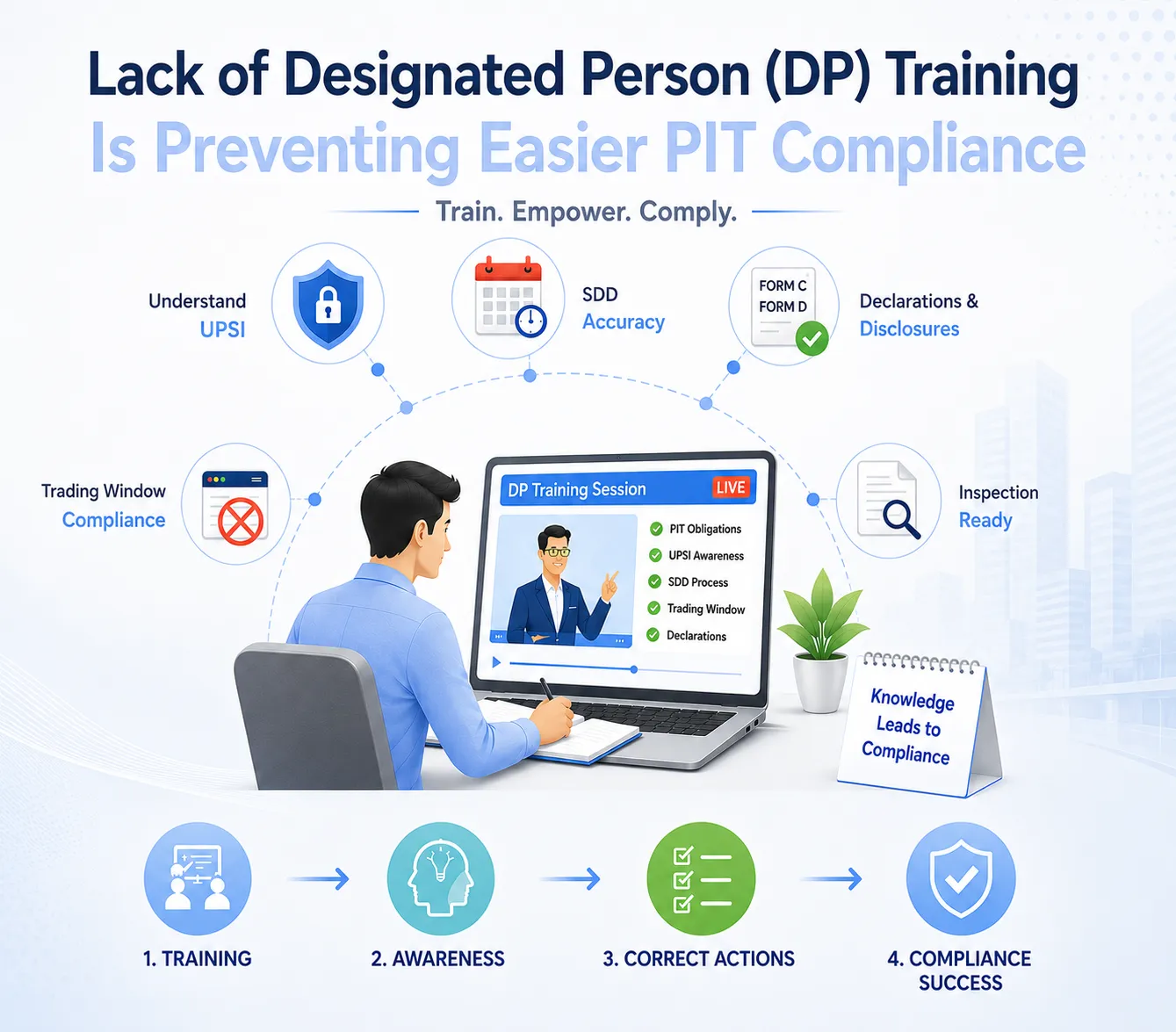
This shows up in several recurring ways. UPSI gets misclassified or not classified at all, simply because the person handling it did not realise it qualified. SDD entries get delayed or skipped, not out of negligence, but because the DP did not know an entry was required at that point. Declaration and disclosure filings, such as Form C and Form D, are missed or filed incorrectly because the underlying transaction was never flagged as reportable. And trading window violations occur when a DP genuinely does not realise a restriction applies to them in that moment.
A recent case involving a listed bank illustrates how far this confusion can extend. Questions arose over whether a senior employee should have been classified as a Designated Person at all, and how that determination was communicated and acted upon internally. When even senior compliance functions face ambiguity on classification, it is unrealistic to expect individual DPs across departments to navigate these distinctions without structured training.
What Untrained DPs Do to SDD Accuracy
The Structured Digital Database is often treated as a system problem. In reality, it is a people problem wearing a system's clothes. The SDD is only as accurate as the entries made into it, and those entries depend entirely on whether the person making them understands what triggers a recording obligation, and when. To start with, a DP must know that she is a DP and must clearly understand the responsibilities of a DP, with regard to UPSI.
An untrained DP may not realise that a verbal discussion about a material development needs to be logged the moment they become privy to it, not after it becomes a formal decision. Under the March 2025 amendment, any UPSI received from outside the listed entity must be entered into the SDD within two calendar days of receipt. This is a hard deadline, and it depends on the DP recognising, in real time, that what they just received qualifies as UPSI in the first place.
When this recognition does not happen, the SDD develops gaps that are invisible during normal operations but become glaring during a SEBI inspection. Inspectors do not just check whether entries exist, they check whether the timeline of entries aligns with the timeline of actual events. A DP who logs an entry late, or not at all, because they did not understand the obligation, creates exactly the kind of misalignment that turns a routine inspection into a deeper inquiry.
Trading Window Violations That Should Not Happen
Trading window violations are frequently framed as discipline failures. In practice, a large share of them are knowledge failures. A DP places a trade believing the window is open, or believing the restriction does not apply to their role, when neither is true.
The March 2025 amendment added a layer of nuance that makes this worse without proper training. It introduced a distinction between UPSI that originates internally, which requires the trading window to remain closed for relevant DPs, and UPSI that originates externally, where the Compliance Officer may determine that closure is not necessary if the DP is unlikely to possess that information. This is a judgment-based distinction, and DPs need to understand it well enough to know that the answer is not always the same.
Consider a DP who receives information from an external party, perhaps during a routine business discussion, and assumes that because it came from outside the company, it does not affect their trading restrictions. Depending on the nature of that information and the Compliance Officer's determination, that assumption could be entirely wrong. Without training on this specific 2025 change, DPs are left applying outdated rules of thumb to a regulation that has deliberately become more situational.
There is also the pre-clearance gap. A DP may seek pre-clearance correctly, but then execute the trade outside the approved quantity, price band, or time window, simply because they did not fully understand what the approval actually covered. The approval existed. The understanding of its limits did not.
Annual Briefings Are Not Enough, Regular Training Is a Must
For most listed companies, DP training means one session a year, usually delivered close to the annual compliance calendar, covering the Code of Conduct in broad strokes. DPs sign an acknowledgment, and the box is marked as ticked. The problem is that this format was never designed to keep pace with a regulation that changes as often as PIT Regulations now do.
The March 2025 amendment alone introduced changes significant enough to require a fresh round of training on their own, the expanded 16-category UPSI definition, the two-calendar-day SDD timeline for externally sourced UPSI, and the revised trading window closure rules. An annual session held before these changes took effect would leave every DP operating on outdated assumptions for months, possibly longer, until the next cycle.
A more practical approach treats training as a continuous process rather than a calendar event. This does not mean constant disruption. It means shorter, targeted sessions triggered by specific events, a regulatory amendment, the addition of new DPs mid-cycle, or a pattern of errors the Compliance Officer has noticed in SDD entries or pre-clearance requests. New DPs added after the annual cycle, whether through promotions, new hires, or expanded roles, often receive no formal training until the next scheduled session, sometimes many months later. During that gap, they carry full DP obligations with none of the context.
Role-specific training also matters more than generic sessions. A finance team member handling fund-raising discussions faces different UPSI scenarios than someone in HR managing a senior leadership transition. Scenario-based training, built around situations DPs are actually likely to encounter in their specific roles, helps people recognise UPSI when it appears in the form it usually takes, as an offhand comment, an early draft, or a partial update, rather than as a clearly labelled document.
The recent case involving a listed bank also points to another training gap that is rarely addressed, training for senior management and audit committee members on how DP determinations should be handled once a potential issue is identified. Classification confusion at this level cannot be resolved by policy documents alone. It requires people across levels to have a working understanding of how the regulation applies to specific roles, updated as the regulation itself evolves.
How Technology Reinforces What Training Starts
Training builds awareness, but awareness needs to be reinforced at the exact moment a DP is about to act, not weeks later in a review meeting. This is where the right compliance environment makes a measurable difference.
A pre-clearance request that surfaces the relevant restriction at the point of submission, rather than expecting the DP to recall it from a training session months ago, closes a gap that training alone cannot. Real-time alerts about trading window status, tied to whether the DP is on a restricted list for internally or externally originated UPSI, remove the guesswork the 2025 amendment otherwise introduces.
Visible audit trails also give Compliance Officers something training alone cannot, a way to see where knowledge gaps are actually occurring. If a particular DP repeatedly submits SDD entries late, or if pre-clearance requests from a certain department consistently miss key details, that pattern points directly to where targeted training is needed next. Technology, in this sense, does not replace training. It tells the organisation where training is failing and gives DPs the contextual nudge that training alone cannot deliver at the right moment.
Conclusion
PIT compliance is often discussed in terms of systems, databases, and deadlines, but at its core, it depends on people making the right call in ordinary, everyday moments. A Designated Person who understands what UPSI looks like, when the trading window applies to them, and what their declaration obligations are, is the single most effective compliance control an organisation can have. Training is not a formality that supports compliance from the sidelines, it is the mechanism that makes every other part of the PIT framework function as intended.
Recent regulatory scrutiny across listed entities makes one thing clear, classification confusion and knowledge gaps at the DP level carry consequences that reach far beyond the individual involved. Organisations that treat DP training as a continuous, role-specific process, rather than an annual formality, are the ones best positioned to stay ahead of these risks. Platforms such as Axar Digital's InsiderLens are built to support exactly this, giving Compliance Officers visibility into where DP awareness gaps exist, while reinforcing the right behaviour for DPs at the point of action.
FAQs
1. Why do PIT compliance failures often trace back to Designated Persons rather than systems?
Most PIT systems work as designed, but they depend on DPs correctly identifying UPSI and acting on it in time. If a DP does not recognise a situation as UPSI, no system can correct that gap after the fact.
2. How does the March 2025 amendment affect DP training requirements specifically?
It expanded UPSI to 16 categories, added a two-calendar-day SDD timeline for externally received UPSI, and introduced a distinction between internally and externally originated UPSI for trading window closure. DPs need training on each of these changes to apply them correctly.
3. Is annual DP training enough to stay compliant with current PIT regulations?
Annual training was designed for a regulation that changed infrequently. With amendments like the March 2025 changes, annual sessions leave DPs operating on outdated rules for months, making regular, event-triggered training necessary.
A compliance officer at a mid-sized listed company once described a recurring moment in his work: a Designated Person calls him minutes before placing a trade, asking if it is fine to go ahead, simply because a colleague mentioned the company was "in talks about something." That single call, made out of confusion rather than intent, is one of the most common triggers for SEBI scrutiny today.
Under Section 15G of the SEBI Act, PIT violation penalties start at Rs 10 lakh and can go up to Rs 25 crore, or three times the profit made, whichever is higher. With the March 2025 amendment expanding UPSI to 16 categories, the people who now qualify as Designated Persons, and the situations that count as UPSI, have grown considerably. Yet DP training has not kept pace, and that gap is where compliance programs quietly fail.
The Knowledge Gaps That Create Compliance Failures
Most PIT compliance failures do not begin with a deliberate breach. They begin with a Designated Person who simply does not recognise what they are looking at. A discussion about a possible large order, a draft resignation letter from a senior executive, an internal note about a forensic review, none of these arrive with a label that says UPSI. Without training, a DP may not connect these everyday situations to their compliance obligations at all.
This shows up in several recurring ways. UPSI gets misclassified or not classified at all, simply because the person handling it did not realise it qualified. SDD entries get delayed or skipped, not out of negligence, but because the DP did not know an entry was required at that point. Declaration and disclosure filings, such as Form C and Form D, are missed or filed incorrectly because the underlying transaction was never flagged as reportable. And trading window violations occur when a DP genuinely does not realise a restriction applies to them in that moment.
A recent case involving a listed bank illustrates how far this confusion can extend. Questions arose over whether a senior employee should have been classified as a Designated Person at all, and how that determination was communicated and acted upon internally. When even senior compliance functions face ambiguity on classification, it is unrealistic to expect individual DPs across departments to navigate these distinctions without structured training.
What Untrained DPs Do to SDD Accuracy
The Structured Digital Database is often treated as a system problem. In reality, it is a people problem wearing a system's clothes. The SDD is only as accurate as the entries made into it, and those entries depend entirely on whether the person making them understands what triggers a recording obligation, and when. To start with, a DP must know that she is a DP and must clearly understand the responsibilities of a DP, with regard to UPSI.
An untrained DP may not realise that a verbal discussion about a material development needs to be logged the moment they become privy to it, not after it becomes a formal decision. Under the March 2025 amendment, any UPSI received from outside the listed entity must be entered into the SDD within two calendar days of receipt. This is a hard deadline, and it depends on the DP recognising, in real time, that what they just received qualifies as UPSI in the first place.
When this recognition does not happen, the SDD develops gaps that are invisible during normal operations but become glaring during a SEBI inspection. Inspectors do not just check whether entries exist, they check whether the timeline of entries aligns with the timeline of actual events. A DP who logs an entry late, or not at all, because they did not understand the obligation, creates exactly the kind of misalignment that turns a routine inspection into a deeper inquiry.
Trading Window Violations That Should Not Happen
Trading window violations are frequently framed as discipline failures. In practice, a large share of them are knowledge failures. A DP places a trade believing the window is open, or believing the restriction does not apply to their role, when neither is true.
The March 2025 amendment added a layer of nuance that makes this worse without proper training. It introduced a distinction between UPSI that originates internally, which requires the trading window to remain closed for relevant DPs, and UPSI that originates externally, where the Compliance Officer may determine that closure is not necessary if the DP is unlikely to possess that information. This is a judgment-based distinction, and DPs need to understand it well enough to know that the answer is not always the same.
Consider a DP who receives information from an external party, perhaps during a routine business discussion, and assumes that because it came from outside the company, it does not affect their trading restrictions. Depending on the nature of that information and the Compliance Officer's determination, that assumption could be entirely wrong. Without training on this specific 2025 change, DPs are left applying outdated rules of thumb to a regulation that has deliberately become more situational.
There is also the pre-clearance gap. A DP may seek pre-clearance correctly, but then execute the trade outside the approved quantity, price band, or time window, simply because they did not fully understand what the approval actually covered. The approval existed. The understanding of its limits did not.
Annual Briefings Are Not Enough, Regular Training Is a Must
For most listed companies, DP training means one session a year, usually delivered close to the annual compliance calendar, covering the Code of Conduct in broad strokes. DPs sign an acknowledgment, and the box is marked as ticked. The problem is that this format was never designed to keep pace with a regulation that changes as often as PIT Regulations now do.
The March 2025 amendment alone introduced changes significant enough to require a fresh round of training on their own, the expanded 16-category UPSI definition, the two-calendar-day SDD timeline for externally sourced UPSI, and the revised trading window closure rules. An annual session held before these changes took effect would leave every DP operating on outdated assumptions for months, possibly longer, until the next cycle.
A more practical approach treats training as a continuous process rather than a calendar event. This does not mean constant disruption. It means shorter, targeted sessions triggered by specific events, a regulatory amendment, the addition of new DPs mid-cycle, or a pattern of errors the Compliance Officer has noticed in SDD entries or pre-clearance requests. New DPs added after the annual cycle, whether through promotions, new hires, or expanded roles, often receive no formal training until the next scheduled session, sometimes many months later. During that gap, they carry full DP obligations with none of the context.
Role-specific training also matters more than generic sessions. A finance team member handling fund-raising discussions faces different UPSI scenarios than someone in HR managing a senior leadership transition. Scenario-based training, built around situations DPs are actually likely to encounter in their specific roles, helps people recognise UPSI when it appears in the form it usually takes, as an offhand comment, an early draft, or a partial update, rather than as a clearly labelled document.
The recent case involving a listed bank also points to another training gap that is rarely addressed, training for senior management and audit committee members on how DP determinations should be handled once a potential issue is identified. Classification confusion at this level cannot be resolved by policy documents alone. It requires people across levels to have a working understanding of how the regulation applies to specific roles, updated as the regulation itself evolves.
How Technology Reinforces What Training Starts
Training builds awareness, but awareness needs to be reinforced at the exact moment a DP is about to act, not weeks later in a review meeting. This is where the right compliance environment makes a measurable difference.
A pre-clearance request that surfaces the relevant restriction at the point of submission, rather than expecting the DP to recall it from a training session months ago, closes a gap that training alone cannot. Real-time alerts about trading window status, tied to whether the DP is on a restricted list for internally or externally originated UPSI, remove the guesswork the 2025 amendment otherwise introduces.
Visible audit trails also give Compliance Officers something training alone cannot, a way to see where knowledge gaps are actually occurring. If a particular DP repeatedly submits SDD entries late, or if pre-clearance requests from a certain department consistently miss key details, that pattern points directly to where targeted training is needed next. Technology, in this sense, does not replace training. It tells the organisation where training is failing and gives DPs the contextual nudge that training alone cannot deliver at the right moment.
Conclusion
PIT compliance is often discussed in terms of systems, databases, and deadlines, but at its core, it depends on people making the right call in ordinary, everyday moments. A Designated Person who understands what UPSI looks like, when the trading window applies to them, and what their declaration obligations are, is the single most effective compliance control an organisation can have. Training is not a formality that supports compliance from the sidelines, it is the mechanism that makes every other part of the PIT framework function as intended.
Recent regulatory scrutiny across listed entities makes one thing clear, classification confusion and knowledge gaps at the DP level carry consequences that reach far beyond the individual involved. Organisations that treat DP training as a continuous, role-specific process, rather than an annual formality, are the ones best positioned to stay ahead of these risks. Platforms such as Axar Digital's InsiderLens are built to support exactly this, giving Compliance Officers visibility into where DP awareness gaps exist, while reinforcing the right behaviour for DPs at the point of action.
FAQs
1. Why do PIT compliance failures often trace back to Designated Persons rather than systems?
Most PIT systems work as designed, but they depend on DPs correctly identifying UPSI and acting on it in time. If a DP does not recognise a situation as UPSI, no system can correct that gap after the fact.
2. How does the March 2025 amendment affect DP training requirements specifically?
It expanded UPSI to 16 categories, added a two-calendar-day SDD timeline for externally received UPSI, and introduced a distinction between internally and externally originated UPSI for trading window closure. DPs need training on each of these changes to apply them correctly.
3. Is annual DP training enough to stay compliant with current PIT regulations?
Annual training was designed for a regulation that changed infrequently. With amendments like the March 2025 changes, annual sessions leave DPs operating on outdated rules for months, making regular, event-triggered training necessary.