Blog
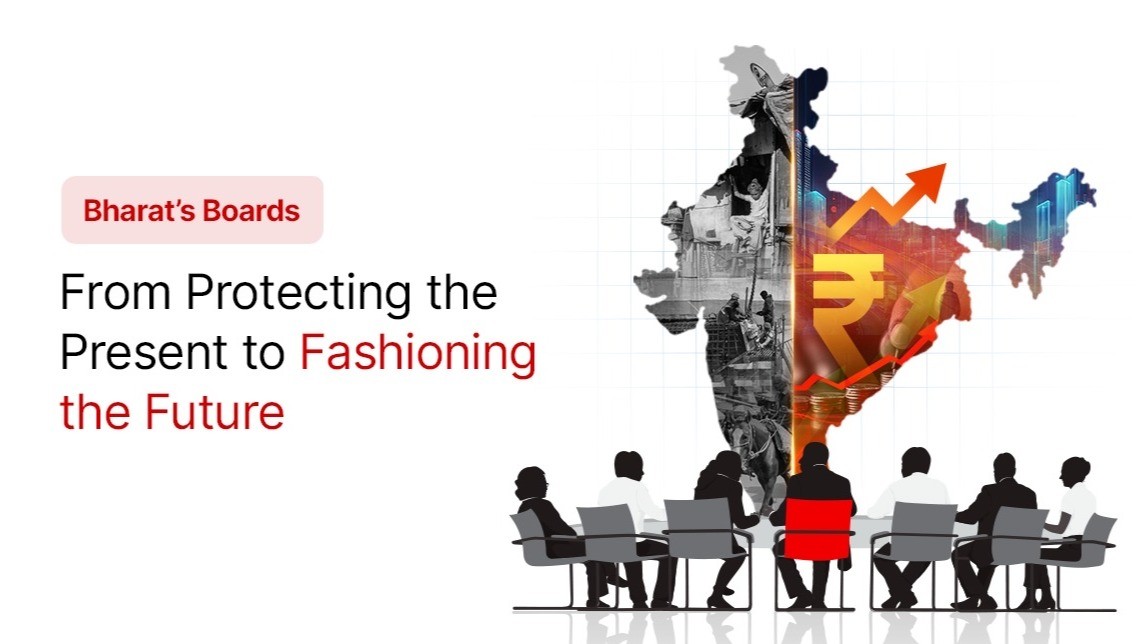
Bharat’s Boards – From Protecting the Present to Fashioning the Future
Dec 2, 2025
When I wrote on August 27, 2025 about the US challenge facing Bharat’s Boards, I highlighted how the US responded to Japan’s rise after 1945—and eventually outpaced both Japan and Germany by investing aggressively in manufacturing, technology, and innovation.
In response to that article, an Independent Director of multiple Boards shared thoughtful feedback. An extract:
The core message is clear: Corporate India must execute a crash programmed to revive manufacturing and R&D—critical not only for the nation but for companies themselves. More manufacturing, more research, more technology, cleaner environments, and more employment—achieved rapidly.
Boards are responsible for ensuring management delivers what all stakeholders—Customers, Investors, Employees, Society—expect. Their primary responsibility remains ROI for investors. Therefore, any crash programmed must convincingly demonstrate eventual value creation. Customers will always embrace useful products at the right price—but investors must see future returns.
Boards do discuss big ideas, but winning propositions materialize only when all stakeholders align.
Two later articles supported this view:
Tavleen Singh, quoting a Mumbai businessman, noted in the Sunday FE (Sept 28, 2025): “Private investment happens when the mood is optimistic, and the numbers add up.”
Madan Sabnavis, Chief Economist at Bank of Baroda, outlined the preconditions for private investment (Oct 3, 2025). According to him, the government has largely met its part through taxation rationalization and policy stability. Private sector hesitation stems from four factors:
Need for sustained demand visibility.
Requirement of acceptable returns on investment.
Low interest rates alone cannot spur investment without opportunity.
High uncertainty since April due to tariff issues, affecting especially export-oriented sectors.
All point to the same imperative: sustained, robust demand—current and future.
Demand Visibility Has Now Materialized
Over the past two months, that clarity has emerged.
PIB Delhi (Nov 3, 2025) reports:
· Gross GST collections in October 2025: ₹1,95,936 crore
· YoY monthly growth (Oct 2024–25): 4.6%
· Domestic GST revenue up 2%, despite lowered rates
· FY26 GST collection (Apr–Oct 2025): ₹10.40 lakh crore, up 7.8% YoY
PIB concludes: Sustained consumption recovery, broadening tax base, and improving fiscal health.
ETBFSI (Nov 15, 2025) echoes this:
· Banks and NBFCs expect credit growth revival in H2FY26.
· Axis Securities forecasts 14% CAGR in credit between FY26–28.
Additional indicators:
· Passenger vehicle demand grew 40% YoY in October 2025.
· Retail expansion plans have been revived across major chains.
· Paint and electricals sectors are experiencing intense competitive churn—an indicator of market opportunity, not stagnation.
What was predicted in August is no longer anticipation—it is now unfolding reality.
This has resulted in accumulation of comfortable free cash. The FE of November 18, talks about “India Inc sitting on cash pile” estimated by Capitaline at ₹14.19 lakh crore at the end of September 2025, across some 3,596 companies.
Beyond Demand: The Imperative of Entrepreneurial Risk-taking
Entrepreneurs do not wait for guaranteed demand. They ask:
· Is there a signal of demand?
· Can demand be created?
History—and markets—show that winners invest ahead of certainty. When demand becomes obvious, it is already too late; incumbents and risk-takers dominate supply.
This does not mean first movers always win. Followers can surpass pioneers—but only if pioneers fail to build robust teams and scalable systems.
Examples abound:
· Akio Morita and the Sony Walkman
· Sam Altman and Microsoft
· Sridhar Vembu and Zoho
· Narayan Murthy and Infosys
· Kiran Mazumdar Shaw and Biocon
· Nandan Nilekani and Aadhaar
· And, in our history: Chhatrapati Shivaji Maharaj and Peshwa Bajirao I, visionaries who acted without “certainty”
The thesis remains unchanged: Measured, informed risk-taking is the foundation of business success.
If some private enterprises do not invest in capacity expansion and R&D—others will. The RCA–Sony story is a timeless reminder.
The Triad Bharat Needs
Bharat requires three types of people working synergistically:
Entrepreneurs who take risks.
Business leaders who can spot sparks and scale them.
Bureaucrats and politicians who create enabling environments.
Is this utopian? Perhaps. Is it necessary? Absolutely. Is there an option? None.
How do we create such an ecosystem? I do not yet know. But I will think—and I hope many more will think—so we may collectively shape the prescription Bharat urgently needs.
A National Example Worth Studying
Japan and Germany stunned the world with the pace of their post–World War II recovery. Germany received vastly more aid:
· US aid (1946–52), in 2005 dollars: Germany: ~$43 billion Japan: ~$22 billion
Yet Japan rose to the 4th largest economy in the world, despite nuclear devastation.
GDP ranking in 2025:
USA – $30.50T
China – $19.23T
Germany – $4.74T
Japan – $4.19T
India – $4.19T
UK – $3.84T
Why did Japan rise so rapidly?
Kenichi Ohmae, in The Mind of the Strategist (1982), offers the answer. From ages 6 to 12, Japanese children were taught one lesson:
“Japan has no resources. To survive, we must import raw materials, add value, and export—or perish.”
A Clear Path for Bharat’s Businesses
Instead of being preoccupied with tariff uncertainties or distant export markets, Bharatiya businesses must leverage our enormous domestic market. By building strong brands and robust product portfolios here, companies can go global from a position of strength.
Two pathways are equally valid and necessary:
· Manufacture world-class products locally, or
· Import raw materials, add significant value, and export
What is essential is value creation, not mere re-labelling of imported goods.
The government is already doing its part—committing:
· ₹93,000 crore per month to infrastructure
· ₹20,000 crore per year, for the next five years, into R&D
Private enterprise must now match this ambition.
Narayana Health stands as one powerful example of what India can build and scale. Their recent acquisition of a UK health care provider brings them specifically to mind.
The next step is for government and industry to jointly identify priority sectors for focused R&D and manufacturing investment.
Corporate boards must transition from governance custodians to strategic growth architects, and lead the nation’s next strategic leap. Not trying to be prescriptive or even ‘suggestive’. Suggestions will emerge with more thinking.
Three Closing Thoughts
Read Dan Wang’s Breakneck. Though addressed to the US, it contains lessons Bharat must internalize.
The Economics Nobel Prize 2025 highlights innovation-led growth—a direction Bharat must embrace.
Beyond lowering taxes and interest rates, government must enhance quality of life and ease of doing business. Taxpayers must clearly see how their contributions improve their lives—not just fund politically expedient rewadis.
More on these three themes and suggestions in the next article.
Link for reference : https://www.linkedin.com/pulse/bharats-boards-from-protecting-present-fashioning-future-modak-yhruf
When I wrote on August 27, 2025 about the US challenge facing Bharat’s Boards, I highlighted how the US responded to Japan’s rise after 1945—and eventually outpaced both Japan and Germany by investing aggressively in manufacturing, technology, and innovation.
In response to that article, an Independent Director of multiple Boards shared thoughtful feedback. An extract:
The core message is clear: Corporate India must execute a crash programmed to revive manufacturing and R&D—critical not only for the nation but for companies themselves. More manufacturing, more research, more technology, cleaner environments, and more employment—achieved rapidly.
Boards are responsible for ensuring management delivers what all stakeholders—Customers, Investors, Employees, Society—expect. Their primary responsibility remains ROI for investors. Therefore, any crash programmed must convincingly demonstrate eventual value creation. Customers will always embrace useful products at the right price—but investors must see future returns.
Boards do discuss big ideas, but winning propositions materialize only when all stakeholders align.
Two later articles supported this view:
Tavleen Singh, quoting a Mumbai businessman, noted in the Sunday FE (Sept 28, 2025): “Private investment happens when the mood is optimistic, and the numbers add up.”
Madan Sabnavis, Chief Economist at Bank of Baroda, outlined the preconditions for private investment (Oct 3, 2025). According to him, the government has largely met its part through taxation rationalization and policy stability. Private sector hesitation stems from four factors:
Need for sustained demand visibility.
Requirement of acceptable returns on investment.
Low interest rates alone cannot spur investment without opportunity.
High uncertainty since April due to tariff issues, affecting especially export-oriented sectors.
All point to the same imperative: sustained, robust demand—current and future.
Demand Visibility Has Now Materialized
Over the past two months, that clarity has emerged.
PIB Delhi (Nov 3, 2025) reports:
· Gross GST collections in October 2025: ₹1,95,936 crore
· YoY monthly growth (Oct 2024–25): 4.6%
· Domestic GST revenue up 2%, despite lowered rates
· FY26 GST collection (Apr–Oct 2025): ₹10.40 lakh crore, up 7.8% YoY
PIB concludes: Sustained consumption recovery, broadening tax base, and improving fiscal health.
ETBFSI (Nov 15, 2025) echoes this:
· Banks and NBFCs expect credit growth revival in H2FY26.
· Axis Securities forecasts 14% CAGR in credit between FY26–28.
Additional indicators:
· Passenger vehicle demand grew 40% YoY in October 2025.
· Retail expansion plans have been revived across major chains.
· Paint and electricals sectors are experiencing intense competitive churn—an indicator of market opportunity, not stagnation.
What was predicted in August is no longer anticipation—it is now unfolding reality.
This has resulted in accumulation of comfortable free cash. The FE of November 18, talks about “India Inc sitting on cash pile” estimated by Capitaline at ₹14.19 lakh crore at the end of September 2025, across some 3,596 companies.
Beyond Demand: The Imperative of Entrepreneurial Risk-taking
Entrepreneurs do not wait for guaranteed demand. They ask:
· Is there a signal of demand?
· Can demand be created?
History—and markets—show that winners invest ahead of certainty. When demand becomes obvious, it is already too late; incumbents and risk-takers dominate supply.
This does not mean first movers always win. Followers can surpass pioneers—but only if pioneers fail to build robust teams and scalable systems.
Examples abound:
· Akio Morita and the Sony Walkman
· Sam Altman and Microsoft
· Sridhar Vembu and Zoho
· Narayan Murthy and Infosys
· Kiran Mazumdar Shaw and Biocon
· Nandan Nilekani and Aadhaar
· And, in our history: Chhatrapati Shivaji Maharaj and Peshwa Bajirao I, visionaries who acted without “certainty”
The thesis remains unchanged: Measured, informed risk-taking is the foundation of business success.
If some private enterprises do not invest in capacity expansion and R&D—others will. The RCA–Sony story is a timeless reminder.
The Triad Bharat Needs
Bharat requires three types of people working synergistically:
Entrepreneurs who take risks.
Business leaders who can spot sparks and scale them.
Bureaucrats and politicians who create enabling environments.
Is this utopian? Perhaps. Is it necessary? Absolutely. Is there an option? None.
How do we create such an ecosystem? I do not yet know. But I will think—and I hope many more will think—so we may collectively shape the prescription Bharat urgently needs.
A National Example Worth Studying
Japan and Germany stunned the world with the pace of their post–World War II recovery. Germany received vastly more aid:
· US aid (1946–52), in 2005 dollars: Germany: ~$43 billion Japan: ~$22 billion
Yet Japan rose to the 4th largest economy in the world, despite nuclear devastation.
GDP ranking in 2025:
USA – $30.50T
China – $19.23T
Germany – $4.74T
Japan – $4.19T
India – $4.19T
UK – $3.84T
Why did Japan rise so rapidly?
Kenichi Ohmae, in The Mind of the Strategist (1982), offers the answer. From ages 6 to 12, Japanese children were taught one lesson:
“Japan has no resources. To survive, we must import raw materials, add value, and export—or perish.”
A Clear Path for Bharat’s Businesses
Instead of being preoccupied with tariff uncertainties or distant export markets, Bharatiya businesses must leverage our enormous domestic market. By building strong brands and robust product portfolios here, companies can go global from a position of strength.
Two pathways are equally valid and necessary:
· Manufacture world-class products locally, or
· Import raw materials, add significant value, and export
What is essential is value creation, not mere re-labelling of imported goods.
The government is already doing its part—committing:
· ₹93,000 crore per month to infrastructure
· ₹20,000 crore per year, for the next five years, into R&D
Private enterprise must now match this ambition.
Narayana Health stands as one powerful example of what India can build and scale. Their recent acquisition of a UK health care provider brings them specifically to mind.
The next step is for government and industry to jointly identify priority sectors for focused R&D and manufacturing investment.
Corporate boards must transition from governance custodians to strategic growth architects, and lead the nation’s next strategic leap. Not trying to be prescriptive or even ‘suggestive’. Suggestions will emerge with more thinking.
Three Closing Thoughts
Read Dan Wang’s Breakneck. Though addressed to the US, it contains lessons Bharat must internalize.
The Economics Nobel Prize 2025 highlights innovation-led growth—a direction Bharat must embrace.
Beyond lowering taxes and interest rates, government must enhance quality of life and ease of doing business. Taxpayers must clearly see how their contributions improve their lives—not just fund politically expedient rewadis.
More on these three themes and suggestions in the next article.
Link for reference : https://www.linkedin.com/pulse/bharats-boards-from-protecting-present-fashioning-future-modak-yhruf