Blog
Managing Market Rumours Under SEBI Reg 30(11): The 24-Hour Compliance Challenge
Jun 24, 2026
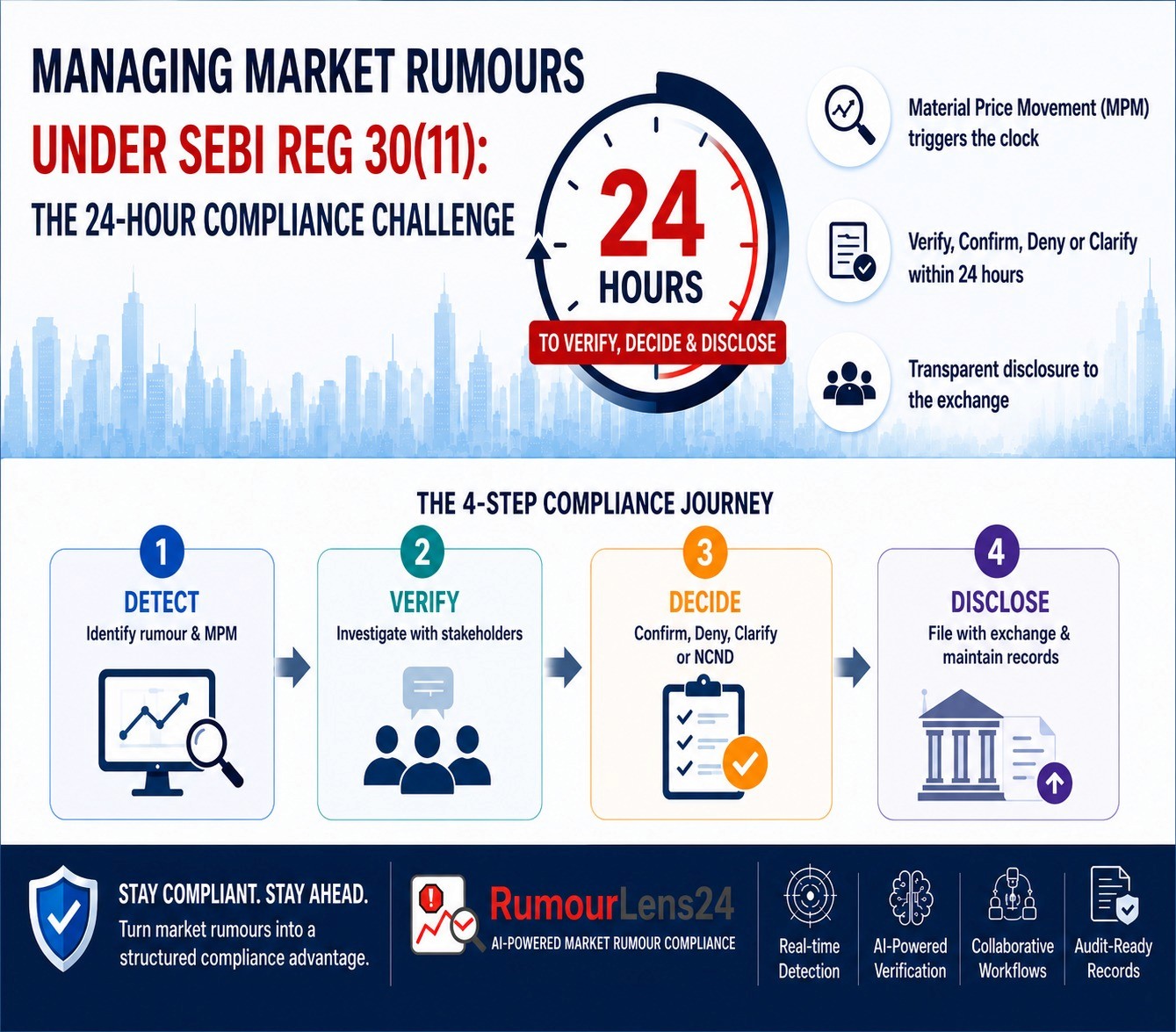
Now suppose that a rumour regarding your company gets aired on a financial news channel at 9:15 AM. By 9:30 AM, your stock price moves significantly against the benchmark index. In such a case, your compliance department has only 24 hours to decide whether the rumour needs to be confirmed, coordinated with other stakeholders, and then disclosed in the exchange.
SEBI Regulation 30(11) and accompanying Industry Standards mandate that companies should now adhere to the process of confirming or denying rumours in the market within 24 hours of Material Price Movement (MPM).
This seems like a very simple requirement on paper but is quite difficult to implement. Suppose that the rumour has been circulated through various digital forums, television channels, e-papers, and financial news agencies in minutes. Now the compliance department must figure out whether the rumour needs to be acted upon, verified internally, and then disclosed to the exchange, all within the stipulated time frame.
The outcome is the increased requirement for regulated market rumour verification software that can stand up to regulatory scrutiny and enable quick decision-making.
Understanding SEBI Reg 30(11) and Rumour Verification Requirements
SEBI introduced rumour verification requirements to improve market transparency and reduce information asymmetry between companies and investors.
Under Regulation 30(11), eligible listed entities must verify, confirm, deny, or clarify material and specific market rumours reported in mainstream media when accompanied by a Material Price Movement (MPM).
The emphasis is no longer merely on whether a rumour exists. The trigger is whether:
A Material Price Movement (MPM) has occurred
The information is specific and identifiable
The rumour relates to an impending or ongoing event
This creates a compliance environment where companies must maintain continuous awareness of both market activity and media narratives.
Price Movement Thresholds Under the Regulation
Share Price Range | Minimum Price Variation to Trigger MPM |
Rs. 200 and above | 3% variance vs. benchmark index |
Rs. 100 to Rs. 199.99 | 4% variance vs. benchmark index |
Below Rs. 100 | 5% variance vs. benchmark index |
Why Market Rumours Create Significant Disclosure Pressure
Market rumours often emerge before organizations have complete visibility into underlying facts.
Examples may include:
· Mergers and acquisitions
· Strategic investments
· Leadership changes
· Divestments
· Large contracts
· Regulatory developments
In many cases, internal discussions are still evolving when rumours become public.
This creates a difficult situation:
· The market expects immediate answers
· Internal verification may still be underway
· Compliance teams must balance regulatory obligations with the need to avoid inaccurate disclosures
The challenge becomes even greater when rumours originate from multiple media sources simultaneously and begin influencing trading activity.
The Real Challenge: Verifying Rumours Within 24 Hours
The 24-hour requirement sounds manageable until organizations map the actual workflow required.
Step 1: Detecting the Trigger
The company must first identify:
Material Price Movement
Relevant media reports
Potential disclosure obligations
Without automated monitoring, this process itself can consume valuable time.
Step 2: Internal Investigation
Teams may need input from:
Company Secretaries
Legal departments
Compliance officers
Senior management
Key Managerial Personnel (KMPs)
Gathering responses from multiple stakeholders can create delays.
Step 3: Determining the Appropriate Response
The organization must decide whether to:
· Confirm
· Deny
· Clarify
· Issue a Neither Confirm Nor Deny (NCND) response where applicable
Step 4: Filing and Documentation
The final disclosure must be submitted while maintaining a complete audit trail of the verification process.
Every delay reduces the margin for compliance.
The Consequences of Getting It Wrong
Non-compliance with SEBI Reg 30(11) carries serious consequences under Section 23E of the Securities Contracts (Regulation) Act:
Monetary penalties for failure to disclose within the prescribed window
Increased regulatory scrutiny of your governance and disclosure controls
Reputational damage with investors and the broader market
Operational disruption as teams scramble to manage a compliance event without a defined process
And it is not just about missing the 24-hour deadline.
Why Documented Verification Workflows Are Becoming Essential
Organizations need documented workflows that demonstrate:
When was the rumour identified?
Who reviewed the information?
What verification steps were performed?
How were decisions reached?
When were disclosures approved and filed?
A structured verification workflow creates consistency, accountability, and defensibility.
Without clear documentation, companies may struggle to demonstrate compliance during audits, inspections, or regulatory reviews.
How AI Is Changing Market Rumour Compliance
Traditional monitoring relies on news alerts, manual searches, and media tracking agencies. These approaches struggle to keep pace with today's information environment. Rumour verification software driven by AI changes that.
AI-driven monitoring enables continuous visibility across multiple media sources simultaneously.
Instead of waiting for rumours to be escalated manually, organizations can identify potential compliance events as they emerge.
Benefits include:
Faster detection
Broader media coverage
Reduced manual effort
Improved response coordination
Better documentation
As regulatory expectations increase, technology is becoming a critical component of disclosure compliance programs.
Faster Verification and Disclosure Coordination
One of the biggest challenges under SEBI Reg 30(11) is coordinating multiple stakeholders within 24 hours.
A structured rumour verification software helps by:
Centralizing rumour reports, supporting media coverage, stakeholder comments, and disclosure drafts in a single workspace
Standardizing verification, review, approval, and disclosure workflows
Automating notifications and escalations
Accelerating review cycles
Maintaining visibility across the entire compliance process
Faster coordination means more time spent on verification and decision-making instead of administrative follow-up.
This becomes especially valuable during high-pressure compliance events where every hour matters.
Building Continuous Visibility Into Rumour-Related Compliance
As disclosure requirements become more dynamic, organizations need continuous monitoring rather than periodic checks.
Effective compliance programs increasingly require:
Ongoing market surveillance
Automated trigger detection
Centralized documentation
Audit-ready records
Continuous visibility enables organizations to respond proactively instead of reactively.
This shift transforms rumour management from a compliance burden into a structured governance process.
RumourLens24: Built for Reg 30(11) from the Ground Up
Axar Digital's RumourLens24 is a purpose-built disclosure compliance platform designed to manage the complete Reg 30(11) compliance lifecycle. From the moment an MPM is triggered to the moment your exchange filing is archived, RumourLens24 handles every step.
Do Not Let the Next MPM Catch You Unprepared
SEBI Reg 30(11) is mandatory for the top 250 listed entities. Every MPM event starts a 24-hour countdown. Missing it means monetary penalties under Section 23E of SCRA.
RumourLens24 is India's most advanced AI-powered platform for market rumour compliance. Real-time MPM detection, AI rumour verification, compliant draft responses, and one-click exchange filing. All in one system.
Contact Axar Digital or book a demo of RumourLens24 to see the platform in action with your own company data. Our compliance specialists will walk you through everything in 30 minutes!
FAQs
1. Which companies fall under the SEBI Regulation 30(11) mandate?
The mandate strictly applies to the top 250 listed entities in India, requiring them to officially confirm, deny, or clarify material and specific market rumours.
2. What exactly triggers the 24-hour compliance countdown?
The clock starts only when a specific, non-vague rumour about an impending event appears in mainstream media alongside a Material Price Movement (MPM) in the company’s stock.
3. How does the regulation define a Material Price Movement (MPM)?
It is triggered by a share price variance against the benchmark index of 3% for shares priced at ₹200 and above, 4% for shares between ₹100–₹199.99, and 5% for shares below ₹100.
4. What are the penalties if a company misses the 24-hour response deadline?
Non-compliance carries severe monetary penalties under Section 23E of the SCRA, along with increased regulatory scrutiny and lasting reputational damage with investors.
5. How can I see RumourLens24 in action to secure my company's compliance workflow?
You can protect your organization from regulatory risks by contacting Axar Digital today to book a personalized, 30-minute demo of RumourLens24 .
Now suppose that a rumour regarding your company gets aired on a financial news channel at 9:15 AM. By 9:30 AM, your stock price moves significantly against the benchmark index. In such a case, your compliance department has only 24 hours to decide whether the rumour needs to be confirmed, coordinated with other stakeholders, and then disclosed in the exchange.
SEBI Regulation 30(11) and accompanying Industry Standards mandate that companies should now adhere to the process of confirming or denying rumours in the market within 24 hours of Material Price Movement (MPM).
This seems like a very simple requirement on paper but is quite difficult to implement. Suppose that the rumour has been circulated through various digital forums, television channels, e-papers, and financial news agencies in minutes. Now the compliance department must figure out whether the rumour needs to be acted upon, verified internally, and then disclosed to the exchange, all within the stipulated time frame.
The outcome is the increased requirement for regulated market rumour verification software that can stand up to regulatory scrutiny and enable quick decision-making.
Understanding SEBI Reg 30(11) and Rumour Verification Requirements
SEBI introduced rumour verification requirements to improve market transparency and reduce information asymmetry between companies and investors.
Under Regulation 30(11), eligible listed entities must verify, confirm, deny, or clarify material and specific market rumours reported in mainstream media when accompanied by a Material Price Movement (MPM).
The emphasis is no longer merely on whether a rumour exists. The trigger is whether:
A Material Price Movement (MPM) has occurred
The information is specific and identifiable
The rumour relates to an impending or ongoing event
This creates a compliance environment where companies must maintain continuous awareness of both market activity and media narratives.
Price Movement Thresholds Under the Regulation
Share Price Range | Minimum Price Variation to Trigger MPM |
Rs. 200 and above | 3% variance vs. benchmark index |
Rs. 100 to Rs. 199.99 | 4% variance vs. benchmark index |
Below Rs. 100 | 5% variance vs. benchmark index |
Why Market Rumours Create Significant Disclosure Pressure
Market rumours often emerge before organizations have complete visibility into underlying facts.
Examples may include:
· Mergers and acquisitions
· Strategic investments
· Leadership changes
· Divestments
· Large contracts
· Regulatory developments
In many cases, internal discussions are still evolving when rumours become public.
This creates a difficult situation:
· The market expects immediate answers
· Internal verification may still be underway
· Compliance teams must balance regulatory obligations with the need to avoid inaccurate disclosures
The challenge becomes even greater when rumours originate from multiple media sources simultaneously and begin influencing trading activity.
The Real Challenge: Verifying Rumours Within 24 Hours
The 24-hour requirement sounds manageable until organizations map the actual workflow required.
Step 1: Detecting the Trigger
The company must first identify:
Material Price Movement
Relevant media reports
Potential disclosure obligations
Without automated monitoring, this process itself can consume valuable time.
Step 2: Internal Investigation
Teams may need input from:
Company Secretaries
Legal departments
Compliance officers
Senior management
Key Managerial Personnel (KMPs)
Gathering responses from multiple stakeholders can create delays.
Step 3: Determining the Appropriate Response
The organization must decide whether to:
· Confirm
· Deny
· Clarify
· Issue a Neither Confirm Nor Deny (NCND) response where applicable
Step 4: Filing and Documentation
The final disclosure must be submitted while maintaining a complete audit trail of the verification process.
Every delay reduces the margin for compliance.
The Consequences of Getting It Wrong
Non-compliance with SEBI Reg 30(11) carries serious consequences under Section 23E of the Securities Contracts (Regulation) Act:
Monetary penalties for failure to disclose within the prescribed window
Increased regulatory scrutiny of your governance and disclosure controls
Reputational damage with investors and the broader market
Operational disruption as teams scramble to manage a compliance event without a defined process
And it is not just about missing the 24-hour deadline.
Why Documented Verification Workflows Are Becoming Essential
Organizations need documented workflows that demonstrate:
When was the rumour identified?
Who reviewed the information?
What verification steps were performed?
How were decisions reached?
When were disclosures approved and filed?
A structured verification workflow creates consistency, accountability, and defensibility.
Without clear documentation, companies may struggle to demonstrate compliance during audits, inspections, or regulatory reviews.
How AI Is Changing Market Rumour Compliance
Traditional monitoring relies on news alerts, manual searches, and media tracking agencies. These approaches struggle to keep pace with today's information environment. Rumour verification software driven by AI changes that.
AI-driven monitoring enables continuous visibility across multiple media sources simultaneously.
Instead of waiting for rumours to be escalated manually, organizations can identify potential compliance events as they emerge.
Benefits include:
Faster detection
Broader media coverage
Reduced manual effort
Improved response coordination
Better documentation
As regulatory expectations increase, technology is becoming a critical component of disclosure compliance programs.
Faster Verification and Disclosure Coordination
One of the biggest challenges under SEBI Reg 30(11) is coordinating multiple stakeholders within 24 hours.
A structured rumour verification software helps by:
Centralizing rumour reports, supporting media coverage, stakeholder comments, and disclosure drafts in a single workspace
Standardizing verification, review, approval, and disclosure workflows
Automating notifications and escalations
Accelerating review cycles
Maintaining visibility across the entire compliance process
Faster coordination means more time spent on verification and decision-making instead of administrative follow-up.
This becomes especially valuable during high-pressure compliance events where every hour matters.
Building Continuous Visibility Into Rumour-Related Compliance
As disclosure requirements become more dynamic, organizations need continuous monitoring rather than periodic checks.
Effective compliance programs increasingly require:
Ongoing market surveillance
Automated trigger detection
Centralized documentation
Audit-ready records
Continuous visibility enables organizations to respond proactively instead of reactively.
This shift transforms rumour management from a compliance burden into a structured governance process.
RumourLens24: Built for Reg 30(11) from the Ground Up
Axar Digital's RumourLens24 is a purpose-built disclosure compliance platform designed to manage the complete Reg 30(11) compliance lifecycle. From the moment an MPM is triggered to the moment your exchange filing is archived, RumourLens24 handles every step.
Do Not Let the Next MPM Catch You Unprepared
SEBI Reg 30(11) is mandatory for the top 250 listed entities. Every MPM event starts a 24-hour countdown. Missing it means monetary penalties under Section 23E of SCRA.
RumourLens24 is India's most advanced AI-powered platform for market rumour compliance. Real-time MPM detection, AI rumour verification, compliant draft responses, and one-click exchange filing. All in one system.
Contact Axar Digital or book a demo of RumourLens24 to see the platform in action with your own company data. Our compliance specialists will walk you through everything in 30 minutes!
FAQs
1. Which companies fall under the SEBI Regulation 30(11) mandate?
The mandate strictly applies to the top 250 listed entities in India, requiring them to officially confirm, deny, or clarify material and specific market rumours.
2. What exactly triggers the 24-hour compliance countdown?
The clock starts only when a specific, non-vague rumour about an impending event appears in mainstream media alongside a Material Price Movement (MPM) in the company’s stock.
3. How does the regulation define a Material Price Movement (MPM)?
It is triggered by a share price variance against the benchmark index of 3% for shares priced at ₹200 and above, 4% for shares between ₹100–₹199.99, and 5% for shares below ₹100.
4. What are the penalties if a company misses the 24-hour response deadline?
Non-compliance carries severe monetary penalties under Section 23E of the SCRA, along with increased regulatory scrutiny and lasting reputational damage with investors.
5. How can I see RumourLens24 in action to secure my company's compliance workflow?
You can protect your organization from regulatory risks by contacting Axar Digital today to book a personalized, 30-minute demo of RumourLens24 .