Blog
Governance Beyond Checklists: Reimagining PIT Compliance for Modern Organizations
02 Aug 2026

Too often, PIT compliance is approached as a procedural formality. Every box on the compliance checklist appears neatly checked. Yet enforcement actions continue to rise.
Why Checklist-Driven PIT Compliance Often Fails
Completing compliance activities does not always produce compliance outcomes. Many organizations focus on procedural tasks such as:
Maintaining insider trading policies
Recording disclosures
Sending trading window notifications
Collecting employee declarations
Conducting periodic audits
These activities satisfy procedural requirements. They do not always prevent compliance failures. The real risks often appear during day-to-day operations.
For example, a finance team prepares quarterly financial results. Investor Relations coordinates communication. External auditors receive financial information. Merchant bankers and consultants join discussions.
Every additional participant increases the number of people handling UPSI. Without structured controls, information spreads faster than organizations expect – and possibly leaks.
Common weaknesses include:
Inconsistent insider identification
Delayed Structured Digital Database (SDD) updates
Email-based approvals
Fragmented communication
Digital Compliance as an Established Expectation
The SDD became mandatory from 1 April 2019. Digital compliance is an established regulatory requirement. 7 Years after the SDD mandate, regulators expect companies to maintain complete, accurate, and easily retrievable compliance records in the SDD.
Checklist Compliance | Governance-Driven Compliance |
Periodic activity | Continuous oversight |
Manual controls | Structured digital controls |
Audit preparation | Everyday compliance |
Department-owned | Organization-wide responsibility |
Event-based | Lifecycle-based |
Governance extends beyond identifying UPSI. It continues through controlled sharing, insider identification, SDD maintenance, trading window management, access monitoring, and complete audit trails. Compliance becomes part of everyday decision-making rather than a periodic exercise.
Why Regulators Expect More Than Just SDD
Expectations around insider trading regulations continue to change. Regulators increasingly focus on whether organizations exercised effective control over sensitive information throughout their lifecycle. This includes:
Accountability
Traceability
Controlled information sharing
UPSI access tracking
Evidence supporting compliance processes
Beyond confirming existence of SDD, regulators increasingly ask operational questions like:
Who accessed UPSI?
Why was access granted?
Was the information classified correctly?
Was sensitive information shared outside authorized groups?
Does a complete audit trail exist?
Is the entire information flow traceable?
These questions require structured governance. Organizations must also avoid assuming they are compliant simply because they have not faced regulatory scrutiny. Enforcement is increasingly retrospective, and gaps that exist today may attract significant penalties later.
Information Flow Visibility Is Becoming the Foundation of PIT Compliance
You cannot govern information if you cannot see how it moves. UPSI rarely stays within one department. Take a merger transaction. Multiple internal teams, financial advisors, lawyers, and consultants all access sensitive information. Without structured visibility, organizations struggle to answer basic questions about who accessed information, when, and why.
Information-flow visibility supports:
Controlled access
Accurate insider identification
Reliable SDD records
Role-based permissions
Information ownership
Complete information lifecycle tracking
Visibility is no longer optional. It is the foundation of effective PIT compliance.
SDD: A Fundamental Component of Effective PIT Compliance
The SDD is not simply another compliance record. It forms the backbone of an effective PIT compliance framework by maintaining a complete record of UPSI access. Organizations treating the SDD as a compliance checkbox miss its broader value. A well-maintained SDD demonstrates structured governance, stronger controls over sensitive information, and readiness for regulatory scrutiny.
Audit Readiness Does Not Always Mean Compliance Effectiveness
Many organizations assume complete documentation equals effective compliance.
It does not. An organization with well-maintained records still faces significant risk if:
Sensitive information reached unauthorized individuals
Insider lists became outdated
Access permissions remained active after projects ended
Information sharing lacked oversight
Technology Enables Governance, Not Simply Automation
Modern governance depends on digital systems. Emails, spreadsheets, and disconnected files rarely provide the visibility today's compliance environment demands. A governance-focused compliance platform supports the entire compliance lifecycle through:
Secure UPSI management
Automated SDD maintenance
Structured insider identification
Information access visibility
Trading window management
Complete audit trails
Technology should strengthen governance, not merely digitize manual work.
Building a Proactive PIT Compliance Framework
Organizations looking to strengthen governance and compliance should focus on the complete information lifecycle.
Key priorities include:
Classify UPSI early.
Continuously identify insiders throughout projects and reporting cycles.
Track every movement of sensitive information.
Maintain complete, accurate, and secure SDD records.
Apply role-based access controls and promptly remove unnecessary access.
Build cross-functional accountability across departments and external advisors.
Support governance with digital compliance software that simplifies monitoring, recordkeeping, and audit readiness while reducing manual dependency.
Organizations should also regularly assess their preparedness by asking:
Is our SDD complete and current?
Are insider lists accurate?
Can we trace every movement of UPSI?
Would our records withstand regulatory inspection today?
Are employees receiving continuous UPSI awareness training?
Does our framework manage risk rather than simply document compliance?
Proactive governance reduces regulatory exposure while strengthening long-term compliance maturity.
Build a Governance-Driven PIT Compliance Framework With Axar Digital
Strong governance goes beyond digital tools to encompass evolving regulatory expectations, structured governance practices, and long-term compliance readiness.
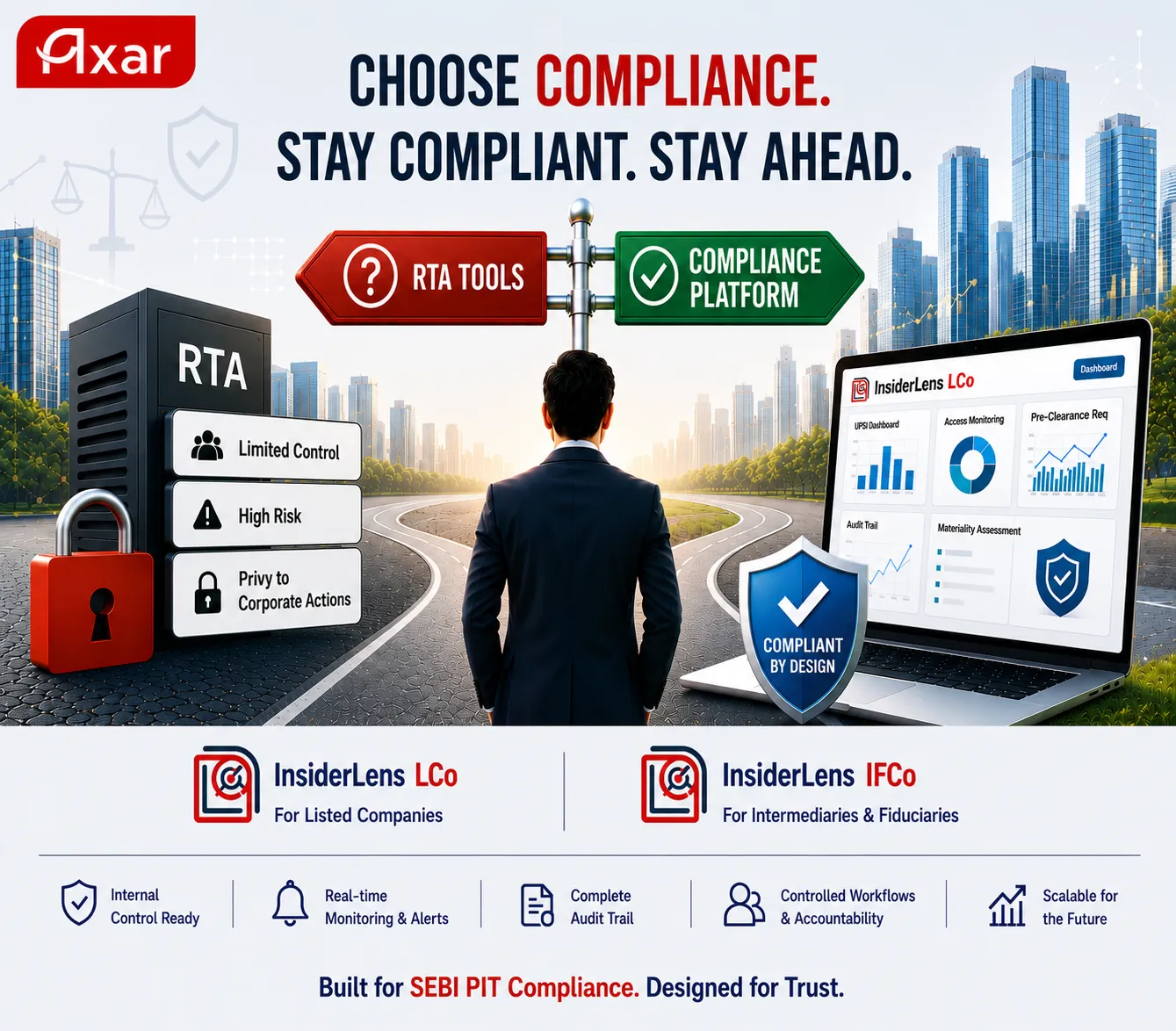
Axar Digital builds governance-focused solutions for listed companies, intermediaries, and fiduciaries. Its InsiderLens platform strengthens PIT compliance through secure UPSI management, SDD maintenance, insider identification, trading window controls, structured disclosure management, secure information sharing, audit-ready records, and end-to-end information traceability.
InsiderLens LCo is designed for listed companies, while InsiderLens IFCo addresses the compliance needs of intermediaries and fiduciaries.
If your organization is ready to move beyond checklist-driven compliance, Axar Digital provides the digital foundation for stronger governance and continuous compliance oversight.
FAQs
1. What is the difference between compliance and governance in PIT compliance?
Compliance focuses on completing required tasks. Governance focuses on continuously managing UPSI, risks, and accountability – by ensuring DP training.
2. Why is information-flow visibility important in PIT compliance?
It helps track UPSI access, maintain accurate SDD records, and supports audit-readiness.
3. How does technology strengthen insider trading compliance?
Secure compliance software improves UPSI management, SDD maintenance, access controls, and trading window management.
4. How can Axar Digital support our PIT compliance efforts?
Axar Digital's InsiderLens helps organizations strengthen PIT compliance with secure UPSI tracking, SDD management, controlled access, and audit-ready digital records.
Too often, PIT compliance is approached as a procedural formality. Every box on the compliance checklist appears neatly checked. Yet enforcement actions continue to rise.
Why Checklist-Driven PIT Compliance Often Fails
Completing compliance activities does not always produce compliance outcomes. Many organizations focus on procedural tasks such as:
Maintaining insider trading policies
Recording disclosures
Sending trading window notifications
Collecting employee declarations
Conducting periodic audits
These activities satisfy procedural requirements. They do not always prevent compliance failures. The real risks often appear during day-to-day operations.
For example, a finance team prepares quarterly financial results. Investor Relations coordinates communication. External auditors receive financial information. Merchant bankers and consultants join discussions.
Every additional participant increases the number of people handling UPSI. Without structured controls, information spreads faster than organizations expect – and possibly leaks.
Common weaknesses include:
Inconsistent insider identification
Delayed Structured Digital Database (SDD) updates
Email-based approvals
Fragmented communication
Digital Compliance as an Established Expectation
The SDD became mandatory from 1 April 2019. Digital compliance is an established regulatory requirement. 7 Years after the SDD mandate, regulators expect companies to maintain complete, accurate, and easily retrievable compliance records in the SDD.
Checklist Compliance | Governance-Driven Compliance |
Periodic activity | Continuous oversight |
Manual controls | Structured digital controls |
Audit preparation | Everyday compliance |
Department-owned | Organization-wide responsibility |
Event-based | Lifecycle-based |
Governance extends beyond identifying UPSI. It continues through controlled sharing, insider identification, SDD maintenance, trading window management, access monitoring, and complete audit trails. Compliance becomes part of everyday decision-making rather than a periodic exercise.
Why Regulators Expect More Than Just SDD
Expectations around insider trading regulations continue to change. Regulators increasingly focus on whether organizations exercised effective control over sensitive information throughout their lifecycle. This includes:
Accountability
Traceability
Controlled information sharing
UPSI access tracking
Evidence supporting compliance processes
Beyond confirming existence of SDD, regulators increasingly ask operational questions like:
Who accessed UPSI?
Why was access granted?
Was the information classified correctly?
Was sensitive information shared outside authorized groups?
Does a complete audit trail exist?
Is the entire information flow traceable?
These questions require structured governance. Organizations must also avoid assuming they are compliant simply because they have not faced regulatory scrutiny. Enforcement is increasingly retrospective, and gaps that exist today may attract significant penalties later.
Information Flow Visibility Is Becoming the Foundation of PIT Compliance
You cannot govern information if you cannot see how it moves. UPSI rarely stays within one department. Take a merger transaction. Multiple internal teams, financial advisors, lawyers, and consultants all access sensitive information. Without structured visibility, organizations struggle to answer basic questions about who accessed information, when, and why.
Information-flow visibility supports:
Controlled access
Accurate insider identification
Reliable SDD records
Role-based permissions
Information ownership
Complete information lifecycle tracking
Visibility is no longer optional. It is the foundation of effective PIT compliance.
SDD: A Fundamental Component of Effective PIT Compliance
The SDD is not simply another compliance record. It forms the backbone of an effective PIT compliance framework by maintaining a complete record of UPSI access. Organizations treating the SDD as a compliance checkbox miss its broader value. A well-maintained SDD demonstrates structured governance, stronger controls over sensitive information, and readiness for regulatory scrutiny.
Audit Readiness Does Not Always Mean Compliance Effectiveness
Many organizations assume complete documentation equals effective compliance.
It does not. An organization with well-maintained records still faces significant risk if:
Sensitive information reached unauthorized individuals
Insider lists became outdated
Access permissions remained active after projects ended
Information sharing lacked oversight
Technology Enables Governance, Not Simply Automation
Modern governance depends on digital systems. Emails, spreadsheets, and disconnected files rarely provide the visibility today's compliance environment demands. A governance-focused compliance platform supports the entire compliance lifecycle through:
Secure UPSI management
Automated SDD maintenance
Structured insider identification
Information access visibility
Trading window management
Complete audit trails
Technology should strengthen governance, not merely digitize manual work.
Building a Proactive PIT Compliance Framework
Organizations looking to strengthen governance and compliance should focus on the complete information lifecycle.
Key priorities include:
Classify UPSI early.
Continuously identify insiders throughout projects and reporting cycles.
Track every movement of sensitive information.
Maintain complete, accurate, and secure SDD records.
Apply role-based access controls and promptly remove unnecessary access.
Build cross-functional accountability across departments and external advisors.
Support governance with digital compliance software that simplifies monitoring, recordkeeping, and audit readiness while reducing manual dependency.
Organizations should also regularly assess their preparedness by asking:
Is our SDD complete and current?
Are insider lists accurate?
Can we trace every movement of UPSI?
Would our records withstand regulatory inspection today?
Are employees receiving continuous UPSI awareness training?
Does our framework manage risk rather than simply document compliance?
Proactive governance reduces regulatory exposure while strengthening long-term compliance maturity.
Build a Governance-Driven PIT Compliance Framework With Axar Digital
Strong governance goes beyond digital tools to encompass evolving regulatory expectations, structured governance practices, and long-term compliance readiness.
Axar Digital builds governance-focused solutions for listed companies, intermediaries, and fiduciaries. Its InsiderLens platform strengthens PIT compliance through secure UPSI management, SDD maintenance, insider identification, trading window controls, structured disclosure management, secure information sharing, audit-ready records, and end-to-end information traceability.
InsiderLens LCo is designed for listed companies, while InsiderLens IFCo addresses the compliance needs of intermediaries and fiduciaries.
If your organization is ready to move beyond checklist-driven compliance, Axar Digital provides the digital foundation for stronger governance and continuous compliance oversight.
FAQs
1. What is the difference between compliance and governance in PIT compliance?
Compliance focuses on completing required tasks. Governance focuses on continuously managing UPSI, risks, and accountability – by ensuring DP training.
2. Why is information-flow visibility important in PIT compliance?
It helps track UPSI access, maintain accurate SDD records, and supports audit-readiness.
3. How does technology strengthen insider trading compliance?
Secure compliance software improves UPSI management, SDD maintenance, access controls, and trading window management.
4. How can Axar Digital support our PIT compliance efforts?
Axar Digital's InsiderLens helps organizations strengthen PIT compliance with secure UPSI tracking, SDD management, controlled access, and audit-ready digital records.